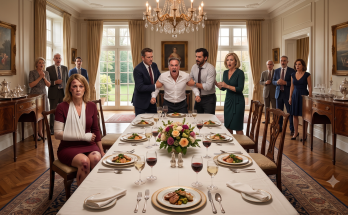
The CEO dropped to one knee so fast that one of the champagne glasses behind him shattered on the marble floor.
Nobody laughed then.
Not Michelle.
Not the retired senator who had called Margaret “a wandering problem.”
Not the real estate heirs who had smirked while an elderly woman’s purse was dumped at her feet.
The ballroom went silent except for the slow drip of red wine falling from Margaret Whitmore’s cream sweater onto the polished stone.
Michelle still had her hand raised.
Her palm was red from the slap.
Margaret’s cheek was red too.
But Margaret’s eyes were perfectly calm.
That calm frightened Michelle more than any shouting could have.
For almost an hour, Michelle had treated Margaret like a trespasser at the grand opening of Royal Palms Legacy Estates, a private senior living community built for people who had family offices, estate attorneys, and last names printed on hospital wings.
The price of entry alone could buy a home in most American towns.
The waitlist was whispered about like membership at an old country club.
And Michelle had made sure everyone knew she controlled that list.
She stood tall in a silver designer gown, her blonde hair pinned high, diamonds at her throat, and a smile that changed depending on the net worth of whoever stood before her.
To donors, she was honey.
To staff, she was glass.
To Margaret, she was poison.
“This,” Michelle had said earlier, gesturing to the ballroom, “is not an open house for lonely seniors looking for free coffee.”
Margaret had been standing near a table displaying framed renderings of the completed campus.
There were villas with private gardens.
A memory-care wing with a rose courtyard.
A clinic wing named after one of the investors.
And a bronze plaque covered with a velvet cloth, waiting to be unveiled at the end of the night.
Margaret had touched the edge of the cloth with two fingers.
Not to pull it.
Just to steady herself.
Michelle saw it from across the room and moved like a hawk.
“Step away from that,” she said.
Margaret turned.
“I’m sorry?”
“You heard me.”
Several guests looked over.
Michelle’s voice grew louder because she liked an audience when she had power.
“That plaque is for donors and board members. It is not a souvenir.”
Margaret smiled faintly.
“I know what it is.”
Michelle looked her over.
The plain sweater.
The old purse.
The sensible shoes.
The tiny pearl brooch.
The silver hair combed back without salon polish.
“No,” Michelle said. “I don’t think you do.”
A man beside her chuckled.
He was Calvin Price, a hotel developer whose father was waiting for a place at Royal Palms. He had spent the whole evening circling Michelle like she held the keys to heaven.
“Michelle,” he said, “you’re too kind. Just have security walk her out.”
Another woman, the wife of a former congressman, leaned closer and whispered loudly enough to be heard.
“Could she be confused? You know how these people get.”
These people.
Margaret heard it.
So did the servers.
So did the nurses standing near the wall.
But in rooms like that, the people with names on the programs expected the people with uniforms to pretend not to hear anything.
Margaret didn’t answer.
She opened her purse and reached for an envelope.
Michelle saw the movement and stepped in.
“What are you doing?”
“Taking out my invitation.”
“You don’t have an invitation.”
“I do.”
Michelle laughed.
It was a perfect laugh for fundraisers.
Soft.
Musical.
Cruel.
“Ma’am, anyone can print something at a library.”
A few people snickered.
Margaret’s hand paused inside the purse.
“Michelle,” she said, “I would suggest you lower your voice.”
That made Michelle angry.
Not because the words were rude.
They weren’t.
But because they were calm.
People like Michelle hated calm from anyone they believed should be embarrassed.
“You would suggest?” Michelle repeated. “You walk into my facility, hover near restricted displays, and now you’re giving me instructions?”
Margaret looked around the ballroom.
At the donors.
At the politicians.
At the board members’ wives.
At the cameras raised just low enough to pretend they weren’t recording.
“This is your facility?” Margaret asked.
Michelle smiled.
“As far as tonight is concerned, yes.”
That was the first lie.
Not the last.
The evening had begun as a celebration.
Royal Palms Legacy Estates had been advertised as the crown jewel of elder care in Florida: luxury villas, on-site medical support, award-winning chefs, private therapy pools, botanical gardens, valet transportation, and “dignity-centered aging” printed on every brochure.
Dignity.
That word was everywhere.
On napkins.
On banners.
On donor cards.
Michelle loved the word because it photographed well.
She did not love the thing itself.
By seven o’clock, the ballroom was full of people who wanted what Royal Palms promised: safety for aging parents, status for adult children, and the comfort of knowing that money could soften the frightening parts of old age.
Margaret had arrived alone.
The valet nearly passed over her when she stepped from an ordinary black sedan.
“Ma’am, deliveries are around back,” he said.
She thanked him anyway and walked in.
At registration, a young assistant asked for her name.
“Margaret Whitmore.”
The assistant looked down at the printed guest list.
Her eyes flickered.
Then she looked up too quickly.
“Just one moment, ma’am.”
Before she could say more, Michelle appeared.
Michelle had been told that a “Margaret” might attend, but she had assumed it was one of the widows from the donor board, someone with a driver and a necklace worth more than a nurse’s annual salary.
She had not expected this woman.
This plain woman.
This forgettable woman.
So she made the mistake powerful people make when they are only powerful by appointment.
She confused access with ownership.
“Do you have family here?” Michelle asked.
Margaret answered, “In a way.”
“What does that mean?”
“It means I have a connection to this place.”
Michelle’s eyes narrowed.
“You need to be more specific.”
Margaret glanced toward the stage where the covered plaque waited.
“I will be.”
Michelle took one step closer.
“This event is closed to walk-ins.”
“I didn’t walk in.”
“You arrived without a visible sponsor.”
Margaret looked at the assistant.
The assistant’s face had gone pale.
She had seen the name.
She knew something.
But Michelle’s stare pinned her silent.
“Michelle,” the assistant whispered, “maybe we should check—”
Michelle cut her off.
“Go help the donors at table six.”
The assistant obeyed.
That was how the first chance to avoid disaster walked away in heels.
For the next thirty minutes, Michelle kept Margaret under watch.
She told security to “keep eyes on the sweater.”
She told catering not to serve her wine.
She told a nurse that if Margaret tried to enter the clinic wing, she should be “handled discreetly.”
But there was nothing discreet about what happened next.
Margaret drifted through the ballroom quietly, listening.
She heard Calvin Price brag that his mother’s admission was “basically guaranteed” because he had promised Michelle access to a yacht club donor circle.
She heard the former congressman’s wife say that their family deserved a villa “far more than some anonymous retiree with a sad story.”
She heard Michelle tell a wealthy attorney, “The board trusts me. I know which families reflect the image we’re building.”
The image.
Not care.
Not dignity.
Image.
Margaret did not interrupt.
She did not reveal herself.
She did what women of her generation learned to do when surrounded by people who underestimated them.
She listened.
She remembered.
And she let them speak.
At 7:42 p.m., Michelle made her second mistake.
A pharmaceutical partner had placed a locked educational display near the reception table, showing medication safety systems used in the facility’s clinic. It contained no actual narcotics, but the label said CONTROLLED MEDICATION PROTOCOL in large letters.
Margaret stood beside it while reading a brochure.
Michelle saw her.
In that instant, Michelle had a choice.
She could ask a question.
She could check the guest list.
She could call legal.
Instead, she chose performance.
“Security,” Michelle called.
The music softened.
Heads turned.
Two guards moved forward.
Margaret looked up.
Michelle’s voice filled the ballroom.
“Ma’am, step away from the medical display.”
Margaret folded the brochure.
“I’m only reading.”
“You were seen near restricted medication materials.”
“That case is locked.”
“That’s not the point.”
“What is the point?”
Michelle smiled, because now she had the whole room.
“The point is that this facility protects vulnerable residents from people who wander in pretending to belong.”
A murmur moved through the crowd.
Margaret’s face did not change.
“You’re accusing me of something serious.”
“I’m preventing something serious.”
Calvin Price stepped beside Michelle like a loyal dog hoping to be petted.
“My father is expected to live here,” he said. “I’m glad someone is keeping standards.”
The former congressman’s wife added, “Search her bag. If she has nothing to hide, she won’t mind.”
Margaret looked directly at Michelle.
“You do not have consent to search my purse.”
Michelle tilted her head.
“Consent? This is private property.”
Margaret said, “Private property does not erase personal rights.”
That should have been the sentence that stopped it.
It didn’t.
Michelle snapped her fingers.
One guard hesitated.
The other shifted his weight.
Neither moved.
They were security officers, not police, and even they knew something was wrong.
Michelle noticed their hesitation and felt challenged.
So she did it herself.
She grabbed Margaret’s purse.
The whole room gasped.
Margaret held onto the strap.
“Let go,” Michelle hissed.
“No.”
The tug was brief.
Ugly.
Public.
Margaret stumbled one step, but she did not fall.
The purse opened.
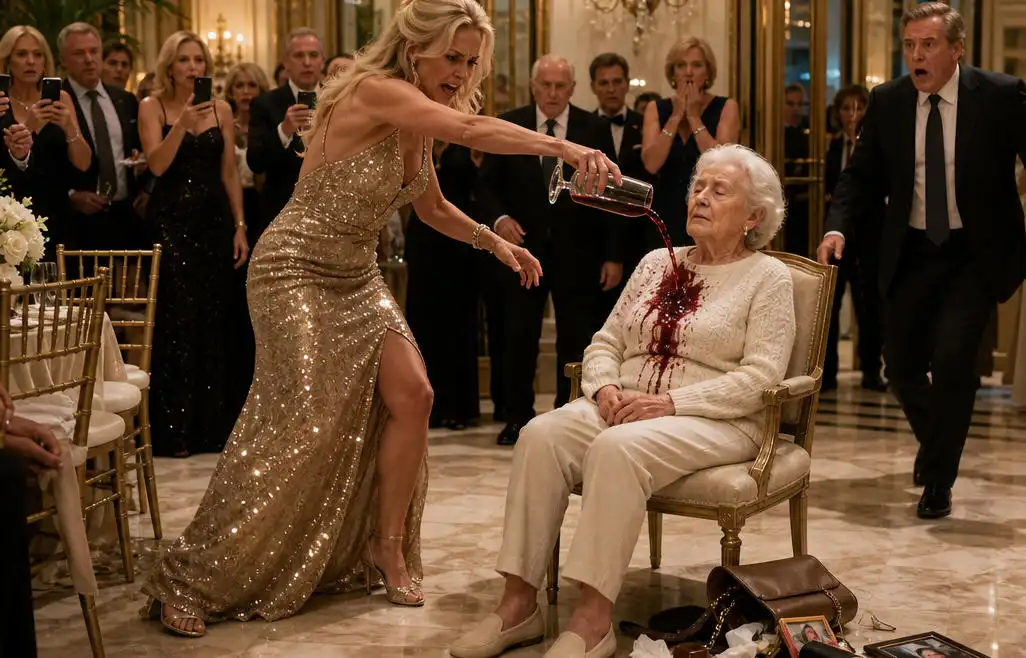
Its contents spilled across the marble.
A lipstick.
A folded handkerchief.
A small pill organizer with blood pressure medication.
A reading glasses case.
An old photograph of Margaret with a man in a Navy uniform.
And a sealed cream envelope embossed with the Royal Palms Legacy Estates crest.
Margaret bent toward the photograph.
Michelle’s heel landed inches from it.
“Don’t touch anything,” Michelle said.
Margaret’s voice dropped.
“That is my husband.”
Michelle glanced at the photo.
“Then he should have taught you not to embarrass yourself in public.”
The slap came next.
It was not accidental.
It was not a brush.
It was not a misunderstanding.
Michelle struck Margaret across the face in front of donors, staff, politicians, and cameras.
The room inhaled as one body.
Margaret touched her cheek.
For a second, something human flickered across Michelle’s face.
Fear.
Then pride smothered it.
She picked up a glass of red wine from a nearby tray.
“Now,” Michelle said, “you’ll leave before I have you arrested.”
And she poured it down Margaret’s sweater.
That was the moment several phones rose higher.
That was the moment the servers stopped moving.
That was the moment even the rich people who had laughed began looking at one another, quietly wondering whether they had just witnessed a mistake too large to bury.
Margaret stood very still.
Wine soaked the wool.
A red line ran down to the pearl brooch.
Her cheek burned.
Her husband’s photograph lay on the floor.
Michelle breathed hard, her perfect image cracking around the edges.
Margaret looked at the phones.
Then at the guards.
Then at the young assistant near registration, who was crying silently.
Finally, Margaret looked back at Michelle.
“Are you certain,” she asked, “you want every person in this room to witness what happens next?”
Michelle’s lips curled.
“Oh, I’m counting on it.”
Then the doors opened.
The State Health Commissioner entered first.
Behind him came Jonathan Reeves, the CEO of Halcyon Crown Properties, the real estate group that had developed Royal Palms.
Behind him came two attorneys, the group’s chief compliance officer, and three members of the state inspection team.
Michelle’s face changed with practiced speed.
She became warm again.
Important again.
“Commissioner,” she said, stepping away from Margaret. “Jonathan. We had a small disturbance, but it’s under control.”
Jonathan did not answer.
His eyes were fixed on Margaret.
He went pale.
Not lightly pale.
Ash pale.
Like a man seeing the floor disappear beneath him.
“Mrs. Whitmore,” he whispered.
The ballroom froze.
Michelle blinked.
“What?”
Jonathan walked past her.
Past Calvin.
Past the donors.
Past the spilled purse.
He reached Margaret, lowered himself to one knee, and picked up the Navy photograph from the floor with both hands.
“I am so sorry,” he said.
Margaret took the photograph.
“Stand up, Jonathan.”
He did not.
Not yet.
“She struck you?”
Margaret looked at Michelle.
“Yes.”
“She searched your bag?”
“She tried.”
“She accused you of theft?”
“In front of everyone.”
The Health Commissioner’s face hardened.
Michelle laughed once.
It came out thin and wrong.
“Jonathan, I don’t know what she told you, but this woman refused to identify herself.”
Margaret turned slightly.
“I gave my name.”
Michelle looked around, desperate for support.
“She said she was invited.”
The young assistant suddenly stepped forward.
Her hands shook.
“She was,” the assistant said.
Michelle snapped, “Emily, not now.”
Emily swallowed.
“I saw the list. Her name was marked Founder Principal. I tried to tell you.”
The words moved through the ballroom like a cold wind.
Founder Principal.
Calvin Price took one step back.
The former congressman’s wife lowered her phone.
Michelle’s mouth opened.
Closed.
Opened again.
Jonathan finally stood.
He faced the room.
“For anyone unaware,” he said, voice shaking with anger, “Mrs. Margaret Whitmore is the majority controlling owner of the land trust that holds Royal Palms Legacy Estates.”
No one moved.
Jonathan continued.
“She is also the principal investor whose family foundation funded the memory-care wing, the nurses’ scholarship program, and the resident dignity charter this facility was legally required to adopt.”
Margaret did not smile.
She did not gloat.
She looked tired.
That made it worse.
Michelle whispered, “That’s not possible.”
Margaret picked up the sealed envelope from the floor.
Wine had stained one corner.
“This was my invitation,” she said. “Inside it is the program for tonight’s dedication.”
Jonathan turned toward the stage.
The covered bronze plaque waited under the velvet cloth.
Margaret nodded once.
An attorney removed the cloth.
The plaque read:
THE EDWARD AND MARGARET WHITMORE CENTER FOR DIGNIFIED AGING Built in honor of every parent, widow, veteran, nurse, and neighbor who deserves respect before wealth.
The silence became unbearable.
Margaret looked at the photograph in her hand.
“My husband grew up poor,” she said. “His mother spent her last years in a county facility where nobody called her by name. He promised me that if we ever had the means, we would build a place where age would never make a person invisible.”
Her voice was quiet.
People leaned in to hear it.
“We did not build this place so gatekeepers could sell dignity to the highest bidder.”
Michelle’s face twisted.
“Margaret, I had no idea—”
“No,” Margaret said. “You had every idea that mattered.”
Michelle flinched.
“You saw an elderly woman alone. You saw plain clothes. You saw no jewelry worth flattering. You saw no family standing beside me. And you decided that made me safe to humiliate.”
A woman in the back whispered, “Oh my God.”
Margaret turned toward the Health Commissioner.
“Commissioner Alvarez, I believe you witnessed enough to begin your review.”
He nodded.
“More than enough.”
Michelle’s voice sharpened.
“Review? This is a misunderstanding.”
The compliance officer stepped forward with a tablet.
“It is not.”
Jonathan looked sick.
“Michelle, this afternoon we received a complaint package from Mrs. Whitmore’s office. We were already opening an internal investigation tonight.”
Michelle stared at Margaret.
“You set me up?”
Margaret shook her head.
“I gave you rope. You chose the knot.”
That line landed harder than the slap.
The compliance officer opened the tablet and read from a prepared summary.
Over the previous six months, multiple families had complained that Michelle pressured them to make “optional donations” to affiliated charities before approving their parents for premium placements.
Two nurses had reported being told to prioritize “high-visibility families” for tours while moving ordinary applicants down the waitlist.
A widower from Ohio had been told no villa was available until his daughter offered to introduce Michelle to a hedge fund donor.
A staff member had recorded Michelle saying, “Compassion is branding. Placement is business.”
The room shifted.
People who had wanted her favor now wanted distance.
Calvin Price looked at his shoes.
The former congressman’s wife whispered to her husband, “We didn’t know.”
Margaret heard her.
She turned.
“You knew enough to laugh.”
The woman went still.
Michelle’s confidence cracked into panic.
“These are disgruntled employees,” she said. “Everyone in leadership knows how competitive these communities are. I was protecting the brand.”
Margaret looked around the ballroom.
“The brand?”
She touched her stained sweater.
“This is your brand.”
Jonathan’s jaw tightened.
“Michelle, effective immediately, you are suspended pending termination.”
Margaret raised one hand.
“No.”
Everyone looked at her.
Jonathan swallowed.
“Mrs. Whitmore?”
Margaret’s eyes never left Michelle.
“Not suspended. Removed. Tonight.”
Michelle’s face drained.
“You can’t do that.”
Margaret handed the wine-stained envelope to the attorney beside her.
“Under Section 9 of the operating agreement, the controlling land trust may remove any executive director for conduct that endangers residents, exposes the facility to regulatory action, or materially damages public trust.”
The attorney nodded.
“That is correct.”
Margaret continued.
“Assaulting an invited founder at a public gala while making false claims about medication theft qualifies.”
The Health Commissioner added, “So does interfering with admission standards tied to care access.”
Michelle took a step back.
“This is insane. Jonathan, tell her.”
Jonathan did not look at her.
“You are no longer authorized to act on behalf of Royal Palms.”
The guards who had hesitated earlier now looked at Michelle.
Not with fear.
With recognition.
The power had moved.
Michelle felt it.
So she did what entitled people often do when rules finally apply to them.
She attacked the messenger.
“You people are unbelievable,” she snapped at Margaret. “You come in dressed like a charity case, bait everyone, and then play victim when someone protects a billion-dollar property.”
A murmur rose.
Margaret’s eyes softened for one brief second.
Not with pity.
With disappointment.
“My husband wore the same Navy jacket for twenty-three years,” she said. “He said clothes should keep you warm, not make you cruel.”
That sentence broke something in the room.
A nurse near the wall began to cry.
Emily, the assistant, covered her mouth.
Michelle looked around and realized the cameras were still recording.
Her own public stage had become her courtroom.
Margaret turned to the attorneys.
“I want all surveillance preserved. Ballroom, entrance, registration desk, clinic hallway.”
“Already initiated,” one attorney said.
“I want witness statements tonight.”
“Yes, ma’am.”
“I want admission files locked and copied for audit.”
“Yes, ma’am.”
“And I want every pending placement tied to donor pressure reviewed by independent counsel.”
Michelle whispered, “You can’t touch my files.”
The compliance officer looked at her.
“They are company files.”
Margaret added, “Your personal financial records tied to suspected kickbacks will be requested through proper legal channels. If a court finds reason to freeze assets connected to misconduct, that will happen by order, not by gossip.”
That was the legal hammer.
Not revenge.
Process.
Not screaming.
Paper.
Contracts.
Witnesses.
Video.
Regulators.
The kind of force polished people fear because charm cannot talk its way out of timestamps.
Michelle tried to leave.
Commissioner Alvarez stopped her with one sentence.
“Ms. Michelle Carrington, state investigators will need your statement before you exit.”
She laughed bitterly.
“Am I under arrest?”
“Not by me,” he said. “But Palm Beach police are on their way regarding the reported assault.”
The word assault landed like a dropped stone.
For the first time all night, Michelle looked at Margaret not as a nuisance, not as a poor old woman, not as a prop.
She looked at her as the person who could end everything.
“Margaret,” she said, voice trembling, “please. I made a mistake.”
Margaret looked down at her husband’s photograph.
“No,” she said. “You made a habit. Tonight you made it public.”
The police arrived at 8:19 p.m.
They did not storm in.
They did not make a spectacle.
They took statements.
They reviewed video from three phones and the facility’s cameras.
They photographed the red mark on Margaret’s cheek.
They photographed the wine-soaked sweater.
They photographed the purse contents on the floor.
And then, in front of the same guests Michelle had spent the evening impressing, an officer informed her that she was being detained in connection with battery and false allegations that had caused public harm.
Michelle’s knees nearly gave out.
Calvin Price turned away.
The former congressman pretended to take a call.
Nobody stepped forward for her.
That was the loneliest part.
Not the handcuffs.
The silence of people who had fed off her cruelty until it became dangerous to stand near it.
As Michelle was led out, she looked back once.
At the chandeliers.
At the donors.
At the plaque.
At Margaret.
Her mouth opened like she wanted to say something final.
Nothing came out.
After she was gone, the ballroom remained frozen.
Margaret could have ended the event.
No one would have blamed her.
Instead, she asked for a towel.
A nurse named Carla rushed forward.
“Mrs. Whitmore, let me help you.”
Margaret smiled at her.
“Thank you, dear.”
Carla dabbed gently at the wine stain.
Her hands shook with anger.
“I’m sorry,” she whispered. “We all knew how she was. We were afraid.”
Margaret placed a hand over Carla’s.
“Fear keeps bad people employed longer than talent ever does.”
Carla cried harder.
Margaret turned to the room.
Some guests looked ashamed.
Some looked defensive.
Some looked frightened because their names were in admission files.
Margaret stepped onto the small stage.
Jonathan tried to offer his arm.
She waved him off.
“I can stand.”
That, more than anything, made people listen.
She stood beneath the unveiled plaque, sweater stained, cheek red, purse still open on a nearby table.
No glamour.
No armor.
Only dignity.
“My husband and I invested in this community because aging should not make people disposable,” she said. “We believed families deserved relief without surrendering their conscience. We believed nurses deserved support. We believed residents deserved names, not price tags.”
She looked at Calvin Price.
“Tonight, some of you laughed while a woman was accused without proof.”
Calvin swallowed.
She looked at the former congressman’s wife.
“Some of you encouraged a search because you assumed innocence belonged only to people who looked expensive.”
The woman’s face crumpled.
Margaret looked at the staff.
“And some of you stayed silent because your jobs were on the line.”
No one breathed.
“I understand fear,” Margaret said. “But from tonight forward, silence will not be the price of employment here.”
Then she announced the first changes.
Royal Palms would be closed to new admissions for thirty days pending review.
Every family on the waitlist would receive written notice that donations, introductions, gifts, and political influence would play no role in placement.
An independent ethics hotline would be opened for staff and families.
Michelle’s authority was terminated immediately.
All compensation, bonuses, and referral arrangements under her leadership would be audited.
Any family found to have participated in improper placement pressure would lose priority status.
Calvin Price stepped forward.
“Mrs. Whitmore,” he said, his voice oily with panic, “surely families shouldn’t be punished for one director’s misunderstanding. My father is ninety-one.”
Margaret looked at him for a long moment.
“Your father deserves care,” she said. “But he does not deserve someone else’s place because you insulted an old woman to impress a gatekeeper.”
His face flushed.
“Our application—”
“Will be reviewed like everyone else’s,” she said.
He looked relieved for half a second.
Then Jonathan stepped in.
“Actually, Calvin, your family’s file includes three recorded communications offering private benefits in exchange for priority placement.”
Calvin’s relief vanished.
Margaret nodded once.
“Then remove them from the premium list. They may reapply through the standard process after the investigation.”
The former congressman tried next.
“My wife was emotional,” he said. “This has been distressing.”
Margaret said, “Yes. Public cruelty often becomes distressing when it is replayed on video.”
His wife began to cry.
Not quiet tears of remorse.
Loud tears of exposure.
Margaret did not comfort her.
Not because she was cruel.
Because comfort given too quickly can become permission.
The night ended without music.
The donors left in clusters, speaking in low voices.
The staff stayed.
Some gave statements.
Some cried.
Some finally told the truth.
By midnight, the first news clip had spread across Facebook.
By morning, every major local outlet had called.
The headline wrote itself.
Luxury Senior Director Slaps Founder at Gala After Mistaking Her for Trespasser.
But the slap was only the doorway.
The investigation behind it was worse.
Michelle had not merely been rude.
She had built a private ladder inside a facility advertised as fair and dignity-centered.
She had marked certain families as “image assets.”
She had delayed applicants whose children were teachers, veterans, small business owners, and retired nurses because they did not bring “strategic value.”
She had accepted luxury trips disguised as consulting retreats.
She had directed vendors toward companies tied to friends.
She had used the fear of aging parents to extract favors from adult children desperate for safe care.
None of it was dramatic in the way movies are dramatic.
It was worse.
It was paperwork cruelty.
The kind that hides behind smiles.
The kind that ruins families one quiet delay at a time.
Three weeks later, Michelle was formally charged with misdemeanor battery for the slap and faced civil claims for defamation and intentional infliction of emotional distress. Separate financial investigations led to fraud-related charges connected to vendor kickbacks and admission manipulation.
A judge froze accounts tied to the alleged misconduct while the civil case moved forward.
Not every asset she owned.
Not a cartoon punishment.
A legal hold on money investigators could trace.
That made it stronger.
Because it was real.
Her industry associations suspended her credentials first.
Then permanently revoked them after the audit became public.
No luxury care group would touch her.
The same families who once begged for her attention stopped answering her calls.
Calvin Price lost his father’s priority placement and later issued a public apology that sounded like a lawyer had written every syllable.
The former congressman’s family withdrew their application after their recorded comments were included in the compliance review.
Several others followed.
Royal Palms reopened sixty days later under interim leadership.
The first permanent change Margaret made was simple.
Every employee, from valet to executive director, would complete dignity training led not by consultants, but by residents, nurses, and family caregivers.
The second change was even simpler.
A framed copy of the resident dignity charter was placed at every entrance.
At the bottom, in Margaret’s handwriting, were twelve words:
If respect depends on wealth, it was never respect at all.
Emily, the assistant who had tried to speak up, was not fired.
Margaret promoted her to admissions integrity coordinator.
Carla, the nurse who had apologized through tears, received the first Edward Whitmore Nursing Scholarship for her daughter.
The memory-care rose courtyard opened in spring.
Margaret attended in the same cream sweater.
Cleaned, repaired, and still faintly stained near the hem.
Jonathan offered to replace it with something “more appropriate for ceremonies.”
Margaret smiled.
“This is appropriate.”
At the courtyard dedication, residents sat under white umbrellas while their families gathered around.
No velvet ropes.
No donor-only section.
No Michelle.
Margaret stood beside the bronze plaque with her husband’s photograph tucked into her purse.
When she spoke, her voice was steady.
“Edward used to say the true test of a place is how it treats someone it thinks has nothing to offer.”
She paused.
A breeze moved through the roses.
“Tonight, this place begins again.”
People clapped softly.
Not the performance applause of the gala.
Real applause.
The kind that feels like relief.
Later, a little boy visiting his grandmother tugged on Margaret’s sleeve.
“Are you the lady from the video?”
His mother looked mortified.
Margaret laughed.
“I suppose I am.”
“Did that woman go to jail?”
The mother whispered, “Ethan.”
Margaret crouched carefully, knees stiff but spirit bright.
“She faced consequences,” Margaret said. “That’s what happens when people forget other people are people.”
The boy thought about that.
“Was your sweater ruined?”
Margaret looked down.
“A little.”
“Why do you still wear it?”
Margaret touched the pearl brooch.
“Because some stains remind people what needed cleaning.”
The mother teared up.
So did Carla, standing nearby.
In the end, Margaret did not destroy Royal Palms.
She saved it from becoming exactly the kind of place her husband had hated.
Michelle lost her title, her career, her access, and eventually her freedom after pleading guilty to fraud-related charges tied to the kickback scheme. The battery charge remained on her record. The defamation case settled with a public apology and a significant payment to Margaret’s foundation, which used every dollar for low-income elder care placements.
Margaret never spent a cent of it on herself.
When asked why, she said, “I already got what I wanted.”
The reporter asked, “Justice?”
Margaret looked toward the rose courtyard, where residents were laughing over lemonade.
“No,” she said. “A reminder.”
“A reminder of what?”
Margaret smiled.
“That dignity is not a luxury amenity.”
And that was the part people shared most.
Not the slap.
Not the wine.
Not even the CEO kneeling.
It was the image of an old woman in a stained sweater standing taller than everyone who had tried to shrink her.
So choose a side:
Michelle deserved every consequence because cruelty in public should meet justice in public.
Or Margaret went too far by letting the whole room watch Michelle fall.
Share this if you believe nobody’s mother, grandmother, or elderly neighbor should ever have to prove they are “important enough” to be treated with respect.