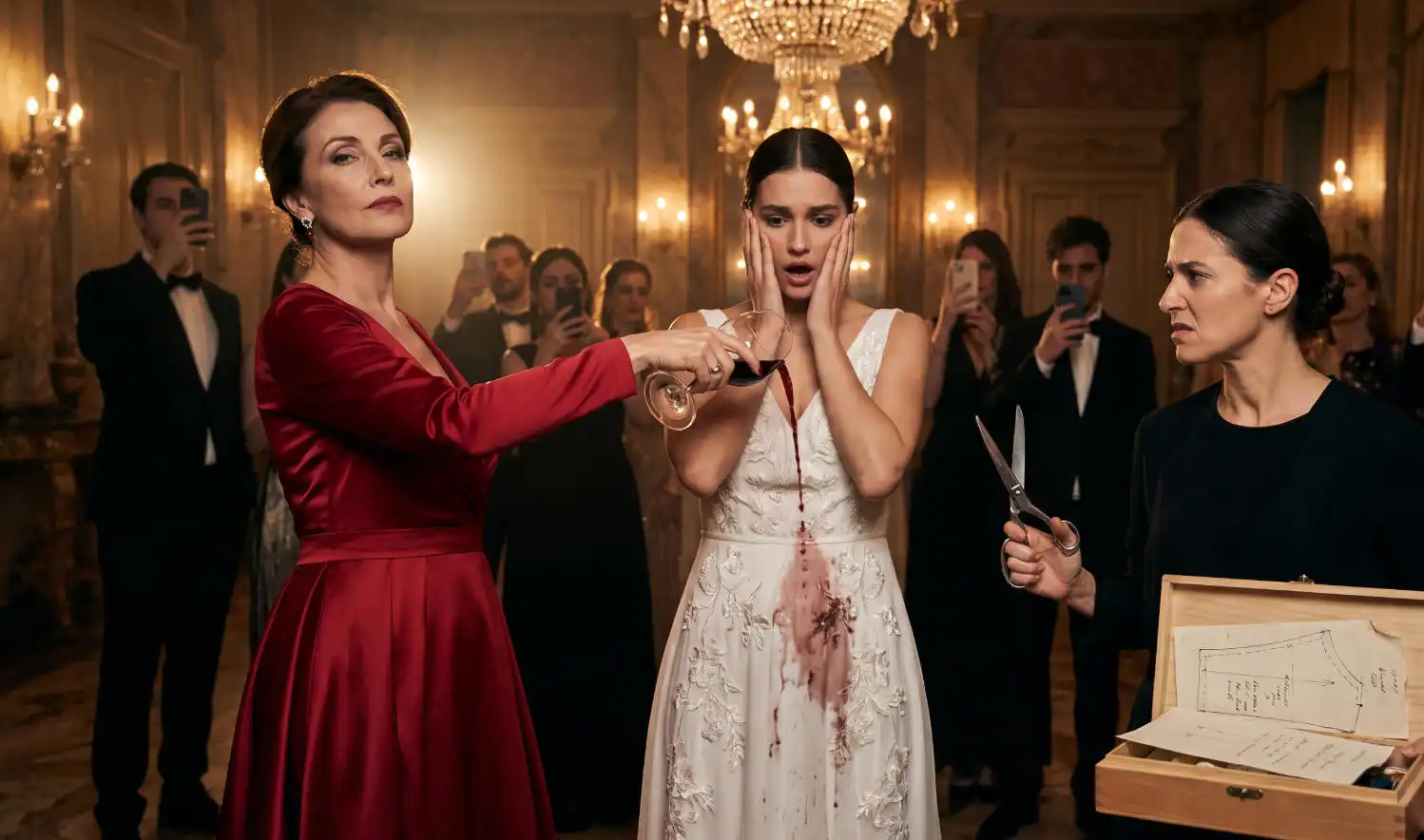
The woman in the silver suit did not hurry.
That made it worse.
Every step she took across that marble floor seemed to drain color from Vivienne Cross’s face.
The music had died.
The laughter had died.
Even the host, who had spent the last ten minutes turning my humiliation into entertainment, lowered his microphone like it had suddenly become too heavy to hold.
I stood beside my model with red wine dripping from the ivory silk I had sewn by hand.
My scissors were still open in my right hand.
One cut had already changed the front panel.
Two more had released the side drape.
The stain Vivienne thought would destroy me was beginning to move like a shadow across the gown.
And now Eleanor Whitcomb was walking straight toward us.
In fashion, there are celebrities.
There are editors.
There are buyers.
Then there is Eleanor.
People called her the Ice Mother of Couture because she could end a designer’s career with one raised eyebrow.
She had built careers.
She had buried frauds.
She had been chair of the Whitcomb Global Fashion Trust for twenty years.
And she never attended private competitions unless something serious had already happened.
Vivienne tried to smile.
It looked painful.
“Eleanor,” she said, her voice suddenly softer. “What a surprise.”
Eleanor did not look at her.
She looked at the gown.
Then at the scissors in my hand.
Then at the red wine stain running down the silk like a public accusation.
“What happened here?” she asked.
The host rushed in before anyone else could speak.
“Just a little dramatic accident,” he said with a fake laugh. “The kind of spirited energy Milan is known for.”
I finally looked at him.
“Accident?”
He swallowed.
Vivienne lifted her chin.
“She was struggling,” she said. “The piece was already weak. I may have brushed the glass too close, but honestly, Eleanor, this whole thing has been blown out of proportion.”
A few guests shifted.
Nobody wanted to be seen defending her now.
But nobody wanted to be first to accuse her either.
That is how public cruelty works.
Everyone sees it.
Everyone hears it.
But until power changes sides, people call it “awkward.”
I was the smallest person in that room.
At least, that was what they thought.
My name is Clara Bell.
Back home in Ohio, my mother used to say my hands were born old.
I was the child who fixed torn hems at church.
The teenager who altered prom dresses for girls whose parents could not afford new ones.
The woman who spent years in the back rooms of bridal shops making rich women look effortless while they never learned my name.
I did not come from fashion money.
I did not intern in Paris.
I did not have a famous mentor writing letters for me.
I came to Milan with one suitcase, two sewing kits, a roll of muslin, and a gown that had nearly broken my back.
Vivienne came with a press team.
Her investors had rented half the hotel.
Her face was on the welcome banner.
Her champagne was being served before judging even began.
And her winning gown, the one waiting behind the black curtain, looked very familiar to me.
Too familiar.
Six months earlier, I had worked in a rented studio in Brooklyn for a “private development consultation.”
That was what the contract called it.
A consulting job.
Cash paid late.
No public credit.
The client had sent an assistant.
No name at first.
Only references.
“Old-world structure.”
“American restraint.”
“A gown that can transform after damage.”
That last line had made me pause.
Transform after damage.
It was an idea I had carried for years.
A dress built for women who had survived public shame.
A gown that could be cut, reshaped, and reborn without losing its dignity.
My mother had inspired it.
She had worn one church dress for fifteen years.
When wine spilled on it at my aunt’s wedding, she did not throw it away.
She cut the skirt shorter, turned the stained panel into a sash, and walked back into the reception like nothing in the world could make her small.
That memory became my design.
I called it The Second Life Gown.
I sketched every panel.
I marked every emergency seam.
I documented every stitch.
Because I had learned the hard way that poor women must keep receipts for dreams rich people want to rename.
When the Brooklyn client vanished without paying the final invoice, I knew something was wrong.
Two months later, Vivienne Cross announced her new collection.
“Rebirth Through Ruin.”
The slogan made my stomach turn.
Then I saw the silhouette.
The hidden side seam.
The curved back panel.
The shoulder release.
She had stolen the bones of my design and wrapped them in money.
I could have screamed online.
No one would have cared.
She had lawyers.
I had rent.
So I did something quieter.
I entered the Milan competition with the original gown.
Not a copy.
Not a protest piece.
The real one.
The version with my mother’s logic inside it.
The version that could survive being ruined.
And I brought proof.
Not just sketches.
Not just photos.
I brought dated pattern drafts.
Fabric purchase receipts.
Tailor’s notes.
A notarized design disclosure from before Vivienne’s collection existed.
Email threads from the Brooklyn assistant.
And the original muslin, folded in tissue paper, marked with my handwriting from six months earlier.
But proof only matters if someone powerful is forced to look at it.
That was why I stayed silent when the host mocked me.
That was why I did not defend myself when the judges kept interrupting my presentation.
That was why I did not flinch when Vivienne circled my model like a hawk.
She wanted me to break in public.
She wanted the judges to see a nobody panic.
She wanted the room to remember one image:
A poor tailor standing beside a stained gown, humiliated beyond repair.
But Vivienne had one problem.
She believed destruction was the end of a dress.
A real tailor knows destruction is just another fitting.
Eleanor stepped closer.
“Miss Bell,” she said.
My stomach tightened.
She knew my name.
“Yes, ma’am.”
“Did you consent to that wine being poured on your garment?”
“No, ma’am.”
A low murmur moved through the room.
Vivienne laughed sharply.
“Oh, please. This is becoming theatrical.”
Eleanor turned to her for the first time.
“Do not confuse theatre with evidence.”
The word evidence landed hard.
Vivienne’s eyes flicked to my sewing kit.
Too late.
I set the scissors down on the table, opened the worn leather folder beneath the kit, and pulled out the first pattern sheet.
The host tried to step between us.
Eleanor raised one finger.
He stopped.
I laid the page flat.
“This is the original front panel,” I said. “Dated January 14. Notarized in Columbus, Ohio.”
A judge leaned forward despite himself.
I placed the second sheet beside it.
“This is the release seam. It allows the bodice to open after staining or tearing.”
Then the third.
“This is the emergency drape.”
Vivienne’s lips parted.
She had seen those pages before.
Not the originals.
Copies.
The ones her assistant had photographed in Brooklyn when she thought I had gone to buy thread.
I reached into the folder again.
“And this is the invoice sent to a shell company called V.C. Concepts LLC.”
The room changed.
Not loudly.
Quietly.
The way a room changes when people realize they may have applauded the wrong person.
One of the judges whispered, “Vivienne…”
She snapped, “I don’t know what she’s talking about.”
Eleanor took the invoice from my hand.
Her eyes moved over the page.
Then she looked at Vivienne.
“V.C. Concepts?”
Vivienne’s laugh was thin.
“That could be anyone.”
I nodded.
“It could.”
Then I pulled out the email printout.
The assistant’s message was simple.
“Miss Cross wants the Brooklyn prototype notes before Thursday. She says the transformation concept must be ready before investor preview.”
Someone near the bar said, “Oh my God.”
Vivienne’s face hardened.
“That email is private. She had no right—”
Eleanor cut her off.
“So it is real.”
Silence.
Vivienne realized what she had done.
The host looked like he wanted to disappear into the floor.
But the worst was not done.
Not for her.
Eleanor turned toward the judges’ table.
“Which of you reviewed Miss Bell’s supporting documents?”
No one answered.
There were four judges.
All polished.
All expensive.
All suddenly fascinated by the tablecloth.
Eleanor repeated, colder this time.
“Which of you reviewed them?”
The oldest judge cleared his throat.
“They were… incomplete when they reached us.”
I opened another envelope.
“No, sir.”
His eyes lifted.
I placed four signed delivery receipts on the table.
“Each packet was delivered to the judging office three days ago. Each contained the same documents. Each was signed for by the competition coordinator.”
The host closed his eyes.
He knew.
Everyone knew.
Vivienne looked at him.
That tiny glance told the whole room more than any confession could.
Eleanor saw it too.
“Mr. Larkin,” she said to the host, “did you withhold materials from the judges?”
He tried to smile.
“Eleanor, let’s not turn a beautiful evening into a tribunal.”
She stared at him.
“It became a tribunal when a contestant’s work was sabotaged in front of witnesses.”
Phones were still recording.
Nobody hid them now.
The wealthy guests who had laughed at me ten minutes earlier were suddenly eager to become witnesses for justice.
That almost made me laugh.
Almost.
Eleanor turned back to me.
“Miss Bell, you began altering the gown after the wine was poured.”
“Yes, ma’am.”
“Was that planned?”
I looked at the stain.
“At some point in every woman’s life, someone tries to make her feel ruined. I built the gown for that moment.”
The room went still.
Even Vivienne stopped moving.
I picked up my scissors again.
“May I finish?”
Eleanor stepped aside.
“Please.”
The model, a young Italian woman named Sofia, looked at me with wide eyes.
“Are you sure?” she whispered.
I smiled at her.
“Hold your shoulders back.”
She did.
I made the next cut.
Snip.
The stained front panel loosened.
A gasp traveled through the crowd.
I folded the wine-darkened silk inward, exposing a hidden lining of deep burgundy beneath the ivory.
The room saw it then.
The stain was no longer damage.
It had become color.
I released the shoulder seam.
The bodice shifted.
The silhouette sharpened.
The gown that had looked wounded now looked dangerous.
Elegant.
Alive.
I cut the lower hem at an angle and pulled a concealed thread from the waist.
The skirt opened into a sweeping asymmetrical train, burgundy beneath ivory, like a rose blooming through snow.
Someone whispered, “That’s impossible.”
It was not impossible.
It was tailoring.
I had spent years making miracles invisible for women who never thanked me.
Now I made one visible for myself.
The guests began to clap.
Not all at once.
First one person.
Then another.
Then the sound filled the room.
Sofia’s eyes filled with tears as she turned slowly beneath the chandelier.
The ruined gown had become the most beautiful thing I had ever made.
Vivienne stood frozen.
For the first time that night, no camera wanted her.
Every lens was on the dress.
Every whisper was about me.
Eleanor waited until the applause softened.
Then she faced the room.
“For the record,” she said, “this competition requires original work, complete disclosure of development history, and immediate disqualification for sabotage, bribery, or plagiarism.”
Vivienne stiffened.
Eleanor continued.
“Based on the documents presented, the physical construction of the garment, the witness recordings, and the misconduct that took place in this room, Vivienne Cross is disqualified.”
A sound came out of Vivienne that was almost a laugh and almost a choke.
“You can’t do that.”
Eleanor did not blink.
“I just did.”
Vivienne pointed at me.
“She is nobody.”
That was her final mistake.
Not the wine.
Not the theft.
That sentence.
Because the whole room heard it.
The guests.
The buyers.
The journalists.
The sponsors.
The assistants who had been treated like furniture all night.
Every person who had ever been invisible to someone like her.
Eleanor’s voice became quiet.
“Fashion is built by nobodies, Miss Cross. The famous ones simply arrive last and take a bow.”
The applause returned, louder this time.
Vivienne backed up a step.
Her lead investor, a silver-haired man who had been laughing with her earlier, pulled out his phone and walked toward the hallway.
A second sponsor followed.
Then a third.
Money is loyal until reputation starts bleeding.
The host tried to recover.
“Ladies and gentlemen, perhaps we should take a short pause—”
“No,” Eleanor said.
She reached into her own silver folder.
“The Whitcomb Global Fashion Trust has also filed an emergency complaint with competition counsel and notified our European legal team regarding intellectual property theft, contract fraud, and false originality declarations connected to Miss Cross’s submitted collection.”
Vivienne’s mouth opened.
Nothing came out.
Eleanor handed a document to her assistant.
“Additionally, all pending Trust-backed retail introductions for Cross Atelier are suspended.”
That was the real knife.
Not a social media scandal.
Not a mean headline.
Retail introductions.
Those were the doors Vivienne had promised her investors.
Luxury department stores.
Private trunk shows.
Global buyers.
Without them, her “empire” was smoke.
Her investor turned back from the hallway.
“Vivienne,” he said quietly, “is this true?”
She looked around for help.
The judges would not meet her eyes.
The host looked sick.
Her assistant had already stepped away from her.
So she did what people like her do when truth corners them.
She attacked the victim.
“She baited me!” Vivienne shouted. “She brought that dress here knowing it could be cut. She wanted this scene.”
I looked at her.
“You poured the wine.”
“She provoked me.”
“I stood there.”
“She copied my aesthetic!”
“You copied my pattern.”
Her voice cracked.
“No one will believe you.”
A dozen phones lifted higher.
One woman near the front said, “We already do.”
That was the moment Vivienne understood the old rules had failed her.
In private, she could bury me.
With money, she could delay me.
Through assistants, she could steal from me.
But in a room full of cameras, with proof on the table and the world’s most feared fashion woman standing beside me, she had nowhere left to hide.
Eleanor stepped to the microphone.
The host handed it over like a man surrendering a weapon.
“Miss Clara Bell,” Eleanor said, “has demonstrated not only original construction, but the rarest form of couture intelligence: the ability to transform damage into design.”
My throat tightened.
I thought of my mother in that church dress.
I thought of all the women in back rooms who knew how to save something everyone else called ruined.
Eleanor turned toward me.
“Miss Bell, by unanimous authority of the Trust, and pending formal judge review now that your documents have been restored to the record, you are the rightful winner of tonight’s Original Couture Prize.”
For a second, I could not breathe.
The room erupted.
Sofia hugged me carefully so she would not crush the gown.
I laughed and cried at the same time.
Not pretty.
Not controlled.
A real cry.
The kind that comes from years of swallowing disrespect because rent was due.
Vivienne screamed, “This is illegal!”
Eleanor looked at her assistant.
“Please escort Miss Cross out.”
Security moved in.
Vivienne stepped back.
“Don’t touch me.”
The security guard kept his voice calm.
“Ma’am, you need to leave.”
Her investor was still on the phone.
I heard the words “pull the funding” and “legal exposure.”
Another sponsor whispered, “Remove our name from the step-and-repeat.”
By morning, every fashion outlet had the video.
By noon, Cross Atelier’s lead investor released a statement suspending all support pending legal review.
By evening, two former interns came forward with stories of stolen sketches.
Within forty-eight hours, three retailers paused her upcoming capsule collection.
The host, Graham Larkin, issued an apology so polished it barely sounded human.
No one cared.
A leaked email showed he had accepted money from Vivienne’s PR team to “manage the narrative” during judging.
He lost two major hosting contracts before the week ended.
As for the judges, the competition board opened an ethics investigation.
Two resigned.
One admitted he had been pressured by sponsors.
The oldest judge sent me a private apology.
I did not answer.
Some apologies are only grief over being caught.
The legal fight lasted months.
Vivienne’s lawyers tried every trick.
They called my work “inspiration.”
They called the invoice “consulting.”
They called the email “ambiguous.”
Then my attorney placed the original muslin on the conference table.
My handwriting was on every seam.
My dates matched the receipts.
My pattern measurements matched Vivienne’s runway sample down to the quarter inch.
Her team settled before trial.
The terms were confidential.
The apology was not.
Vivienne Cross had to publicly acknowledge that key transformation elements in her collection came from my original design work and were used without proper credit or permission.
She did not say my name warmly.
She barely said it at all.
But she said it.
That was enough.
Her brand did not vanish overnight.
That only happens in fairy tales.
But it shrank.
Fast.
Investors left.
Editors stopped calling her fearless and started calling her controversial.
Assistants left for other houses.
The people who once laughed at her cruel jokes began pretending they had always been uncomfortable.
That was almost funny.
My life changed too.
Not in a magical way.
In an overwhelming one.
The morning after the competition, my inbox had so many messages I thought it had broken.
Boutiques.
Brides.
Stylists.
Museums.
Women from small towns.
Women from big offices.
Women who wrote, “I had a red wine moment too.”
The Second Life Gown became more than a dress.
It became a promise.
My first real collection sold out before it existed.
Orders backed up for three years.
Eleanor introduced me to production advisors who did not try to steal from me.
The Whitcomb Trust funded my first atelier in New York.
But I made one condition.
The workroom would be visible from the front.
Glass walls.
Names on the website.
Credit for pattern makers, seamstresses, cutters, finishers.
No invisible hands.
No stolen genius.
On opening day, I hung my mother’s old church dress near the entrance.
Not because it was expensive.
Because it survived.
A reporter asked me if I regretted cutting the gown in Milan instead of waiting for a formal complaint.
I thought about that room.
The laughter.
The wine.
Vivienne’s smile.
The way everyone watched until power gave them permission to care.
“No,” I said. “Some truths need witnesses.”
Months later, I received a package with no return address.
Inside was a pair of gold scissors.
Vintage.
Beautiful.
Heavy.
There was a card from Eleanor.
One sentence.
“Keep cutting what they try to ruin.”
I cried harder over that than I did over the prize.
Not because I needed permission anymore.
Because for the first time, someone powerful had not taken from my hands.
She had honored them.
People still ask me about Vivienne.
Whether I hate her.
Whether I wanted her destroyed.
The truth is simpler.
I wanted my name back.
I wanted my work back.
I wanted every assistant, tailor, intern, and invisible maker in that room to see that proof matters.
Rules matter.
Receipts matter.
And dignity does not mean standing still while someone pours wine on your dream.
Sometimes dignity is silence.
Sometimes dignity is a lawsuit.
And sometimes dignity is picking up your scissors in front of everyone and turning the stain into the most unforgettable part of the dress. ✂️
So choose a side:
Was Clara right to transform the ruined gown in public and expose Vivienne in front of Milan’s elite…
Or should she have stayed quiet and handled it behind closed doors?
Disclaimer: Mention of any brand or trademark is for identification only and does not imply partnership or endorsement