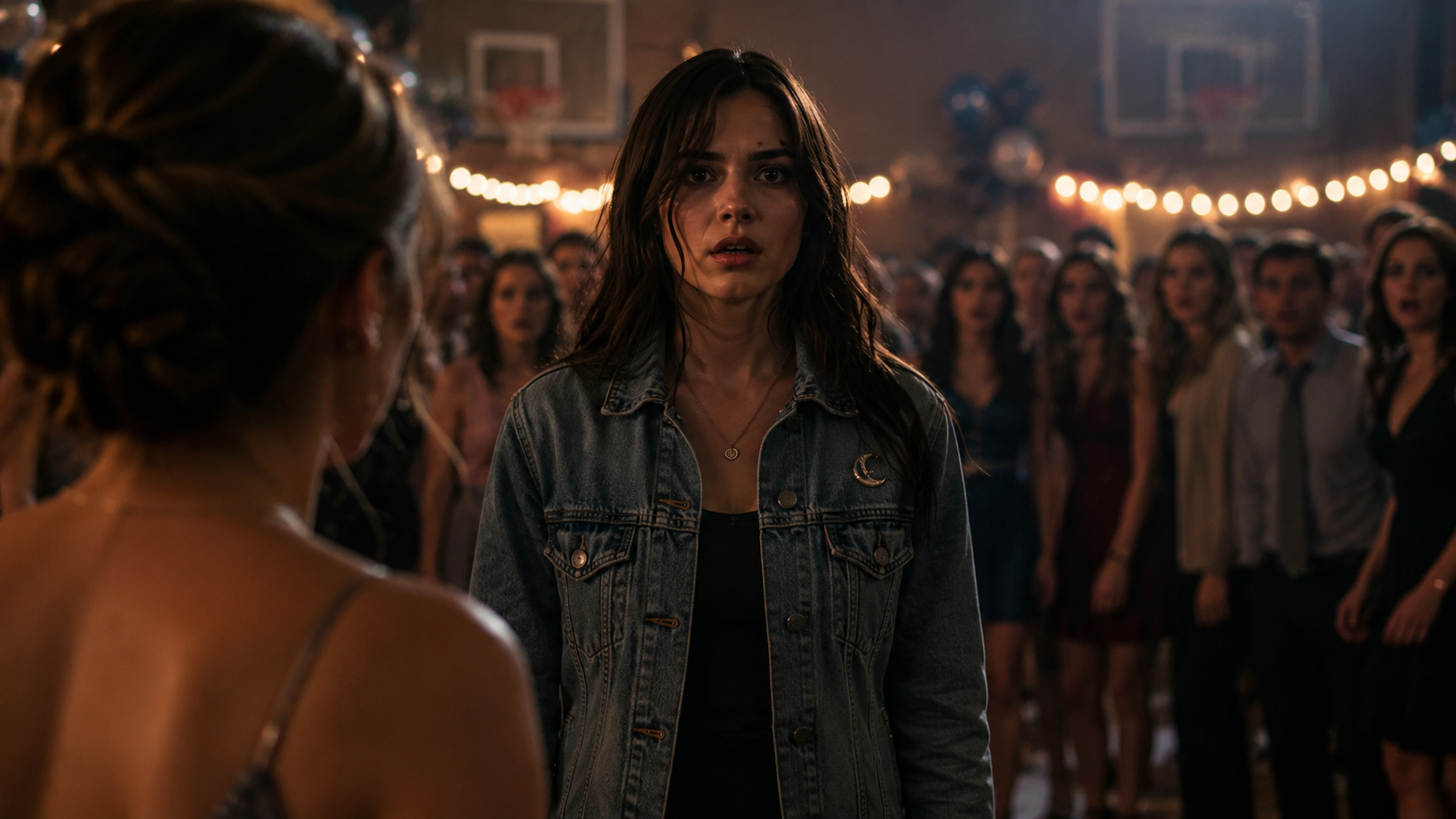
The first thing I noticed was that Sarah was wearing the same denim jacket she had disappeared in ten years ago.
Not one that looked like it.
The same one.
I knew because I had given it to her.
There was a tiny burn mark on the left sleeve from the night we had sneaked behind the football bleachers with a pack of sparklers. One of them had fallen against the denim, leaving a small black crescent near the cuff.
That mark was still there.
So was the silver pin above the right pocket.
A little crooked moon.
My eighteenth-birthday gift to her.
For ten years, I had believed that jacket was buried with her.
And now Sarah was walking toward me across our old high school gymnasium.
Alive.
Or something close to it.
Ten Years Earlier
Sarah Mitchell had been my best friend since we were six years old.
We grew up three houses apart in Bellweather, a small town where everyone knew everyone else’s business before breakfast.
Sarah was the kind of person people remembered.
She laughed too loudly.
Danced when there was no music.
Talked to strangers like they were old friends.
She was fearless in all the ways I wasn’t.
When we were sixteen, she convinced me to climb the old water tower at midnight just to see the town from above.
When we were seventeen, she drove us three hours to the coast because I had never seen the ocean.
And when we were eighteen, three weeks before graduation, she vanished.
Her car was found beside Miller’s Bridge.
The driver’s door was open.
Her phone was on the passenger seat.
One shoe lay near the riverbank.
For four days, volunteers searched the woods and divers searched the river.
On the fifth day, they found a body twelve miles downstream.
The authorities said it was Sarah.
The body had been badly damaged by the river, but the clothes matched. The jewelry matched. Dental records reportedly confirmed the identification.
Her parents held a closed-casket funeral.
I sat in the front row.
I watched her mother collapse against her husband’s shoulder.
I watched the coffin disappear into the ground.
And for ten years, I carried the guilt of our last conversation.
Because the night before Sarah disappeared, she had called me.
And I hadn’t answered.
The Reunion
Our ten-year high school reunion was held in the same gymnasium where Sarah and I had once attended prom.
I almost didn’t go.
But my husband, Daniel, convinced me.
“You might regret it if you stay home,” he said.
So I went.
For the first hour, everything felt ordinary.
Old classmates compared careers, marriages, children, divorces and mortgages.
A DJ played songs from our senior year.
Someone had created a memorial table for the classmates we’d lost.
Sarah’s photograph stood in the center.
She was eighteen in the picture.
Bright eyes.
Dark hair.
That enormous smile.
Beneath the frame were the words:
SARAH MITCHELL
1998–2016
FOREVER YOUNG
At 9:47 p.m., the gymnasium doors opened.
And Sarah walked in.
At first, nobody understood what they were seeing.
The music continued for several seconds.
Then someone screamed.
The DJ stopped the song.
Silence spread across the gym.
Sarah stood beneath the doorway.
She looked exactly eighteen.
Not thirty-eight.
Not older.
Not tired.
Eighteen.
Her hair fell across her shoulders exactly as it had the last time I saw her.
The same denim jacket.
The same black boots.
The same silver necklace.
I couldn’t move.
Someone whispered, “This isn’t funny.”
Another person shouted, “Who are you?”
Sarah ignored them.
Her eyes found me immediately.
Then she began walking.
Straight toward me.
People moved out of her way.
Daniel reached for my hand.
“Emily,” he whispered. “Do you know her?”
I couldn’t answer.
Because Sarah was now standing three feet away.
Close enough for me to see the tiny scar above her eyebrow.
She had gotten it when we were eleven.
No lookalike could have known about that scar.
“Sarah?”
My voice barely came out.
She tilted her head.
Then she smiled.
It was her smile.
My knees nearly gave way.
“Hi, Em.”
I started crying.
Not gently.
Not happily.
I stumbled backward.
“You’re dead.”
The entire gym heard me.
Sarah’s smile disappeared.
“I know.”
Then she stepped closer.
Her hand closed around my wrist.
Her skin was freezing.
She leaned toward my ear.
And whispered:
“You still have the key.”
My blood turned cold.
Because no one knew about the key.
No one except Sarah and me.
The Secret We Buried
When we were seventeen, Sarah and I found an old metal box beneath the floorboards of an abandoned cabin outside town.
Inside were photographs.
Letters.
Newspaper clippings.
And a small brass key.
Most of it meant nothing to us at the time.
But one photograph frightened Sarah.
It showed her father, Thomas Mitchell, standing beside three men outside the Bellweather Municipal Building.
On the back, someone had written:
MILLER PROJECT — 1997
Sarah had been born in 1998.
She took the photograph home.
The next day, she told me her father had become furious.
“He said we should never have opened that box,” she said.
I asked what the Miller Project was.
She wouldn’t tell me.
Instead, she gave me the brass key.
“If anything happens to me,” she said, “keep this.”
I laughed.
I thought she was being dramatic.
“What does it open?”
“I don’t know yet.”
Then she looked at me with an expression I would remember for the rest of my life.
“But someone is willing to kill to keep it locked.”
Three weeks later, Sarah disappeared.
I never told the police about the key.
I was eighteen.
Terrified.
And after Sarah’s death, her father came to my house.
He didn’t threaten me.
He didn’t need to.
He simply said:
“Sarah had a dangerous imagination. Forget whatever stories she told you.”
Then he smiled.
And added:
“It’s safer that way.”
I hid the key inside an old music box.
For ten years, I never touched it.
Until Sarah returned.
“We Need to Leave”
The gymnasium erupted into chaos.
People surrounded us.
Phones appeared everywhere.
Some thought it was a prank.
Others thought Sarah had faked her death.
Her former boyfriend, Jason, pushed through the crowd.
“Sarah?”
She looked at him.
For one second, something changed in her face.
Pain.
Recognition.
Then fear.
She turned back to me.
“We need to leave.”
“What?”
“Now.”
“Sarah, tell me what’s happening.”
She looked toward the gym entrance.
Two men in dark suits had entered.
Sarah’s grip tightened.
“They found me.”
Before I could ask another question, she pulled me toward the emergency exit.
Daniel followed.
We ran.
Outside, rain had begun falling.
Sarah led us across the parking lot toward my car.
“Get in,” she said.
Daniel stopped.
“No.”
Sarah turned.
He stepped between us.
“My wife isn’t going anywhere until you explain who you are.”
Sarah stared at him.
Then she said something that made Daniel go completely still.
“Your name is Daniel Mercer. You married Emily four years ago. You proposed at Lake Harrison because she once told you she wanted to be proposed to near water.”
Daniel’s face changed.
“How do you know that?”
Sarah looked at me.
“Because I’ve been watching.”
I felt sick.
“For how long?”
“Three years.”
“Why didn’t you contact me?”
“Because the people who killed Sarah Mitchell were watching you too.”
The rain seemed to grow louder.
I stared at her.
“What did you just say?”
She stepped closer.
“The girl they buried ten years ago wasn’t me.”
The Body in the River
We drove to my house.
I retrieved the brass key.
Sarah watched me open the music box.
When she saw the key, she began crying.
It was the first time she had shown real emotion since entering the reunion.
“You kept it.”
“You told me to.”
She took it carefully.
Then she told us everything.
The night she disappeared, Sarah had learned what the Miller Project really was.
In the late 1990s, several powerful people in Bellweather had been involved in an illegal land acquisition scheme.
Properties near the river were deliberately declared unsafe.
Families were forced to sell cheaply.
The land was later transferred to private developers for millions.
But that wasn’t the worst part.
One woman discovered the fraud.
Her name was Rebecca Hale.
She threatened to expose everyone involved.
Then she disappeared.
Sarah had found evidence suggesting Rebecca had been murdered.
One of the men connected to the scheme was Sarah’s father.
“I confronted him,” Sarah said.
“He denied everything at first. Then he told me I didn’t understand.”
“What happened that night?” I asked.
“He told me to meet him at Miller’s Bridge. He said he would explain everything.”
She swallowed.
“But when I arrived, he wasn’t alone.”
Two other men were waiting.
Sarah realized they weren’t there to explain anything.
She ran.
A woman driving along the highway saw her and stopped.
Her name was Claire Dawson.
She helped Sarah escape.
But the men followed them.
Claire’s car crashed into the river.
Sarah survived.
Claire didn’t.
The men found Claire’s body.
She was approximately Sarah’s height and build.
And someone made a decision.
They dressed Claire’s body in Sarah’s clothes.
Placed Sarah’s jewelry on her.
Manipulated the identification.
And declared Sarah Mitchell dead.
“Why?” I whispered.
“Because if everyone believed I was dead, no one would search for me.”
“But you survived.”
“Yes.”
“Where have you been for ten years?”
Sarah looked at the brass key.
“Trying to find what this opens.”
The Locker
The key opened a safe-deposit locker.
Not at a bank.
At the old Bellweather train station.
The station had closed in 2002, but part of the building was later converted into private storage.
Sarah had finally discovered a record linking the key number to a locker there.
We drove through the rain.
When we arrived, the building was dark.
Sarah led us downstairs.
Locker 317.
The key fit.
Inside was a black cassette recorder.
A stack of documents.
And a sealed envelope.
On the front:
FOR SARAH MITCHELL
Sarah opened it.
The letter was from Rebecca Hale.
The woman who had disappeared before Sarah was born.
Sarah read silently.
Then her hands began shaking.
“What does it say?” I asked.
She handed me the letter.
The first line changed everything.
Sarah, if you are reading this, then you finally know that Thomas Mitchell is not your biological father.
Sarah stared at me.
Rebecca Hale was Sarah’s mother.
Her real mother.
The woman Sarah had called Mom her entire childhood had adopted her secretly.
Rebecca had discovered the land fraud while pregnant.
She knew powerful people were coming after her.
Before she disappeared, she arranged for her baby to be protected.
Thomas Mitchell had promised to protect Sarah.
Instead, years later, he became part of the very group Rebecca had been trying to expose.
The cassette contained Rebecca’s testimony.
Names.
Dates.
Financial records.
Everything.
Sarah pressed play.
A woman’s voice filled the basement.
“If you’re hearing this, something has probably happened to me.”
Sarah covered her mouth.
The recording continued.
Then footsteps sounded upstairs.
Sarah stopped the tape.
The lights went out.
The Man Who Came Down the Stairs
Someone descended slowly.
One step.
Then another.
A flashlight appeared.
And then a voice.
“Sarah.”
She froze.
I recognized the man immediately.
Thomas Mitchell.
Her father.
Older now.
Gray-haired.
But unmistakable.
Sarah stood.
“You knew I was alive.”
Thomas looked exhausted.
“I hoped you were.”
“You tried to kill me.”
“No.”
“You brought me to that bridge.”
“Because I was trying to get you out of town.”
Sarah laughed bitterly.
“You’re lying.”
Thomas looked toward the darkness behind him.
Then said:
“If I wanted you dead, Sarah, you would never have made it to the bridge.”
Another voice came from upstairs.
“He’s right.”
Thomas’s face changed.
Fear.
He turned.
A gunshot exploded.
Thomas fell down the stairs.
I screamed.
A man appeared above us.
The same man I had seen entering the reunion.
Mayor Richard Vale.
He had been mayor for sixteen years.
He had attended Sarah’s funeral.
He had hugged her mother.
He had given a speech at the dedication of her memorial bench.
And now he was holding a gun.
“Give me the tape,” he said.
Sarah stepped backward.
“No.”
Vale raised the weapon.
Then Daniel did something I will never forget.
He threw a metal chair.
It struck Vale’s arm.
The gun fired into the ceiling.
Sarah lunged forward.
I grabbed the cassette.
Daniel tackled Vale.
For several terrifying seconds, they fought on the stairs.
Then police sirens filled the night.
Sarah had called them before we entered the station.
Not local police.
State investigators.
She had spent ten years building the case.
The cassette was the final piece.
The Truth
Mayor Vale was arrested that night.
So were three former city officials.
An investigation uncovered decades of fraud, intimidation and evidence connected to Rebecca Hale’s disappearance.
Thomas Mitchell survived the gunshot.
And the truth about him was more complicated than Sarah expected.
He had participated in the original land scheme.
But when Rebecca discovered what was happening, Thomas tried to help her.
After Rebecca disappeared, he secretly arranged for Sarah to be raised by his family.
Years later, when Sarah discovered the evidence, he panicked.
He tried to get her out of town.
But Vale and the others followed.
Thomas had spent the next ten years believing Sarah died that night.
He hadn’t switched the bodies.
Vale had.
The dental records had been falsified.
The town had buried Claire Dawson under Sarah’s name.
Claire’s family had spent ten years believing she had simply disappeared.
At last, they learned the truth.
One Year Later
Sarah never became the eighteen-year-old girl I remembered.
She couldn’t.
Neither could I.
She had aged, of course.
The gym lighting, distance and shock had fooled us that night.
But there was something else.
When someone has been dead in your mind for ten years, memory freezes them.
I hadn’t seen a thirty-eight-year-old woman enter that gym.
I had seen my eighteen-year-old best friend walk out of a grave.
The reunion video went viral.
People created theories.
Some claimed Sarah was a ghost.
Others claimed she had never existed.
The truth was stranger, sadder and far more human.
A woman had survived.
Another woman had been buried under the wrong name.
A town had protected powerful people.
And one small brass key had waited ten years to open the truth.
Sarah and I visited the cemetery together after Claire Dawson’s remains were finally returned to her family.
Sarah’s old grave was empty now.
Her headstone had been removed.
Only a rectangle of fresh grass remained.
We stood there quietly.
Finally, Sarah looked at me.
“Do you remember what I whispered to you at the reunion?”
“You asked if I still had the key.”
She shook her head.
“Before that.”
I frowned.
Then I remembered.
When she leaned close, just before mentioning the key, she had whispered something so softly that, in the chaos, I had almost forgotten it.
“You answered.”
My eyes filled with tears.
“The phone call,” she said.
I stared at her.
“I didn’t answer.”
“Yes, you did.”
“No. I saw the missed call the next morning.”
Sarah smiled sadly.
“You answered while you were half asleep. I told you I was scared. You told me to go somewhere safe.”
I couldn’t speak.
“For ten years,” I whispered, “I thought I abandoned you.”
“You didn’t.”
The guilt I had carried since I was eighteen suddenly cracked open.
Sarah took my hand.
We stood beside the empty grave that had carried her name for a decade.
Then she said:
“I came back because I needed the key.”
She squeezed my hand.
“But I walked into that reunion because I needed my best friend.”
And for the first time in ten years, Sarah Mitchell was no longer a photograph on a memorial table.
She was standing beside me.
Alive.
THE END