The Weight of Heavy Canvas
The front door didn’t slam; it groaned.
That was the first detail that slipped through the cracks of my ordinary Thursday afternoon. Usually, my nine-year-old son, Leo, detonated into the foyer like a firecracker. He would drop his neon-blue, light-up Spider-Man backpack onto the hardwood with a plastic clatter, kick off his light-up sneakers into the umbrella stand, and yell for a juice box before his shoes had even stopped rolling.
On this afternoon—July 9, 2026—there was only the low, heavy creak of the hinges and a dead, leaden thud that vibrated right through the floorboards of the kitchen.
“Leo?” I called out, wiping a streak of dish soap onto a dishtowel. “That you, bud?”
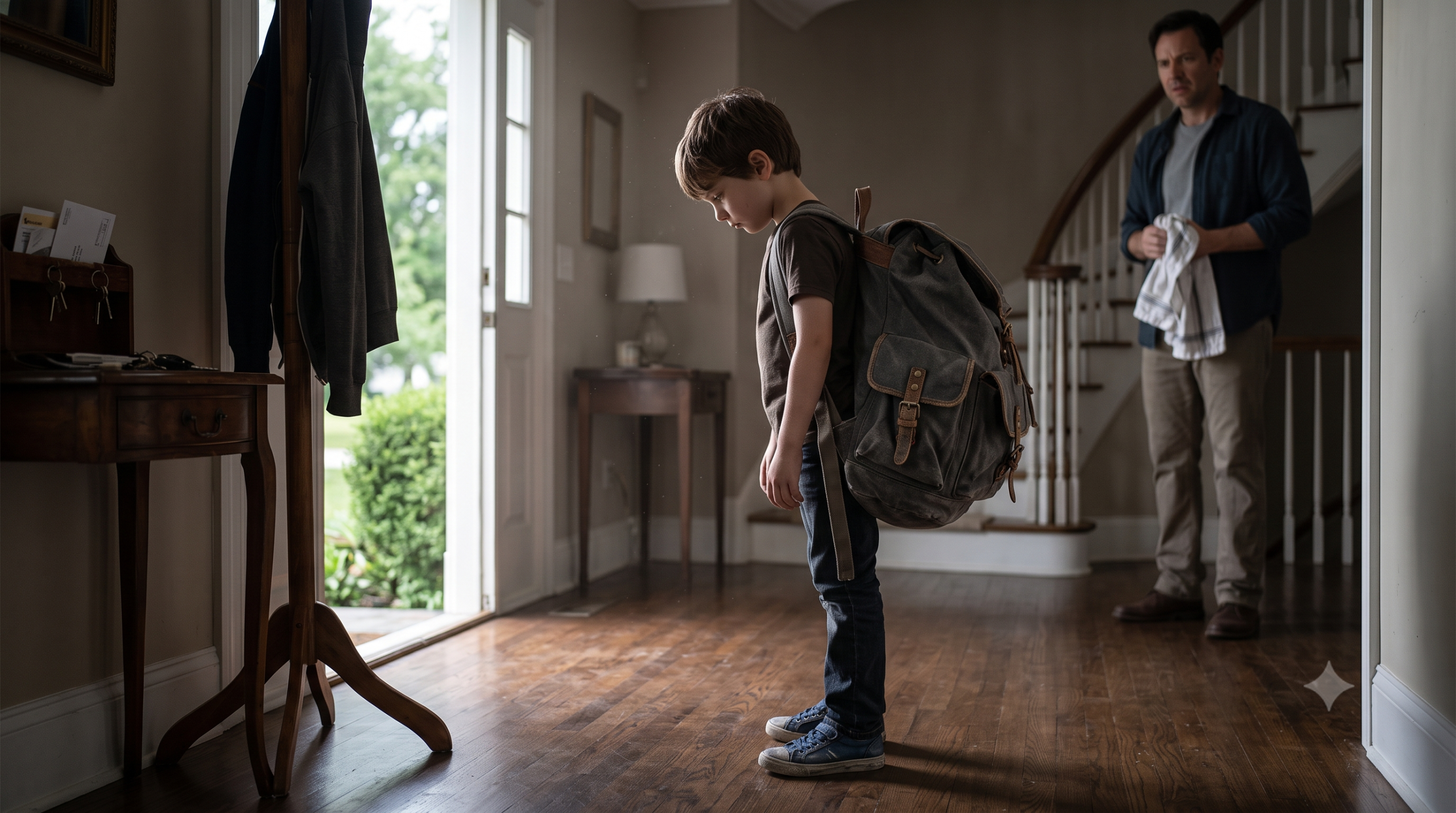
No answer. I walked into the hallway and found him standing by the coat rack. He hadn’t taken off his shoes. He was just staring at the floor, his small shoulders squared beneath a backpack that instantly made my stomach do a strange, unprompted flip.
It wasn’t the Spider-Man bag.
It was a massive, weathered thing made of thick, charcoal-gray canvas. The straps were wide, cracked leather, fastened with heavy brass buckles that looked green around the rivets, oxidized by years of damp air. It looked like something a paratrooper from a bygone war would carry, or a hiker who had spent decades clearing trails in the Pacific Northwest. It was entirely too large for his frame, swallowing his torso so completely that he looked like a turtle hiding beneath a dark, coarse shell.
“Hey,” I said, kneeling down to his eye level. “Whose bag did you swipe by accident? Did you grab a middle-schooler’s locker contents or something?”
Leo didn’t look at me. His eyes remained fixed on the lower brass buckle of the heavy bag. “It’s mine, Dad.”
I laughed, reaching out to ruffle his hair. “Come on, Leo. Your bag has Peter Parker’s face plastered all over it and smells like leaked apple juice. This looks like it was dug out of an attic. Let’s look inside, see if there’s a name tag or a notebook so we can call the school.”
“It’s mine,” he repeated. His voice wasn’t defiant. It wasn’t the stubborn whine he used when he didn’t want to eat his broccoli or go to bed on time. It was flat. Level. It possessed a terrifying, hollow certainty that made the hairs on my arms stand up. “It’s always been mine.”
“Leo, look at me,” I said, my tone sharpening into the firm parental register. He finally lifted his head. His green eyes were clear, but there was an absence in them, a quiet stillness that felt entirely unnatural for a boy who spent his recesses chasing soccer balls. “We bought your backpack at Target three weeks ago. You picked it out because it had the gold web detailing. Remember?”
“No,” Leo said softly. “I picked this one because it has the secret pockets.”
He unbuckled the top flap with a practiced dexterity that sent a chill down my spine. His small fingers didn’t fumble with the stiff, aged leather; they slid the straps through the brass prongs with the effortless muscle memory of someone who had done it thousands of times.
“Stop,” I said, a sudden, irrational surge of panic tightening my throat. I reached forward and gently but firmly took the backpack off his shoulders. It was shockingly heavy—easily thirty pounds. When it hit the floor, it didn’t give the crinkle of school folders or the hollow rattle of a plastic pencil box. It gave a dense, soft whump, like a sack of wet sand.
“Go wash your hands for dinner,” I told him, trying to force a normal, easygoing smile onto my face. “Your mom will be home from the clinic in twenty minutes. We’ll figure out who this belongs to then.”
Leo looked at the bag on the floor, then up at me. For a fleeting second, a shadow of confusion crossed his face—a brief flash of the real Leo, the boy who cried when he scraped his knee. Then his face went blank again.
“Okay, Dad,” he said, turning and walking down the hall toward the bathroom. He didn’t run. He walked with a slow, measured gait that felt entirely too old for his bones.
Chapter 2: Chronology of an Impossible Archive
I dragged the charcoal bag into the kitchen, lifting it onto the island counter. The smell of it hit me then—not the synthetic nylon and cheap dye of modern school supplies, but an olfactory cocktail of old paper, ozone, iron, and a faint, sweet scent that reminded me of dried lavender pressed between the pages of a heavy book.
“Alright, let’s find a phone number,” I muttered to myself, unbuckling the main compartment.
The interior was lined with a dark, waxed cotton. There were no crayons, no crumpled math worksheets with red ink at the top, no half-eaten granola bars. Instead, there was a single, neatly stacked pile of photographs resting at the bottom.
I reached in and pulled them out.
They weren’t digital prints glossed over with modern photo-paper slickness. They were thick, heavy-stock photographs with matte finishes, the kind that felt like thin cardboard beneath your thumb. The edges were slightly rounded, clean and unfrayed.
I turned the first one over.
My breath caught in my windpipe.
It was a picture of me, my wife Clara, and Leo. We were sitting on a red plaid blanket in a field of tall, golden grass under a dramatic, bruised purple sky. I was laughing, my head thrown back, my arm wrapped tightly around Clara’s shoulders. Clara was looking at the camera, her brilliant blue eyes crinkled at the corners, holding a wooden bowl filled with dark cherries. Leo was sitting between us, a wide, toothy grin on his face, holding up a small, wooden whistle.
It was a beautiful, flawlessly composed photo.
The only problem was that we had never been to a field like that. Clara didn’t own a red plaid blanket. I didn’t recognize the dark denim jacket I was wearing in the photo, though it looked perfectly tailored to my frame. And Leo had never owned a wooden whistle.
“What the hell?” I whispered, my heart rate ticking upward.
I shuffled to the next photo.
This one was indoors. It was a shot of our living room—our actual living room, with the built-in bookshelves and the distinctive crown molding I had spent three weekends installing. But the furniture was completely different. In place of our gray sectional, there was a deep hunter-green leather sofa. On the walls, instead of the framed botanical prints Clara loved, there were large, stark black-and-white landscape photographs of jagged mountains.
In the center of the frame, Clara was standing by the window, holding a steaming mug. A soft, morning light caught the side of her face. She looked older. Not aged by decades, but there were deeper lines around her mouth, a subtle, elegant maturity to her features that wasn’t there when she left for work this morning.
“Is this… Photoshop?” I murmured, my mind frantically scrambling for a rational anchor.
I was an architect; I spent my days dealing with digital renderings, spatial manipulation, and high-end software. I knew how easily reality could be forged on a screen. But as I held the print up to the under-cabinet lighting, examining it with a trained eye, I couldn’t find a single digital artifact. The grain was consistent across the entire image. The shadows cast by the morning light fell perfectly across Clara’s cheek, matching the refractive index of the glass in the window behind her. The depth of field was organic, the blur of the background smoothly transitioning into the sharp focus of her sweater.
If this was a fake, it was a masterpiece created by someone with access to Hollywood-grade special effects and an intimate, terrifying knowledge of our private lives.
I went through the rest of the stack, my hands beginning to tremble.
Photo 3: Leo and I in the garage, building what looked like an intricate model of a sailing ship. The garage was cluttered with tools I didn’t own, including a heavy-duty drill press that occupied the corner where our recycling bins usually sat.
Photo 4: Clara and Leo sitting on the steps of a rustic log cabin, surrounded by a dense forest of towering pines. Leo was wearing a yellow raincoat, thick with mud. They were both laughing so hard their eyes were closed.
Photo 5: A close-up of my own hands holding an old-fashioned pocket watch. The crystal was cracked across the center, a jagged lightning bolt of fractured glass. The hands of the watch were stopped at exactly 4:13.
The front door clicked open, and the familiar sound of Clara’s keys jingling brought me crashing back to reality.
“David?” she called out, her voice carrying the exhausted cadence of someone who had spent eight hours dealing with hospital administration. “Can you help me with the groceries? The strap on the insulated bag is about to snap.”
I didn’t answer. I couldn’t move. I just stood there, holding the stack of impossible lives in my hands.
Chapter 3: The Intrusive Timeline
“David?”
Clara walked into the kitchen, a brown paper bag balanced on her hip. She stopped when she saw my face. Her expression immediately shifted from exhaustion to alarm. She dropped the groceries onto the island, the sound of a plastic container of blueberries rattling against the counter.
“What is it? Is Leo okay? Did something happen?”
“Leo’s fine,” I managed to say, my voice sounding tight, like a wire stretched to its breaking point. “He’s in the bathroom. But… Clara, you need to look at this.”
I laid the photographs out on the granite countertop, spreading them like a deck of tarot cards.
Clara frowned, stepping closer. She picked up the first image—the one of us in the golden field. “What… where did you find these? Did my sister send these to you? I don’t remember doing a photoshoot in the valley.”
“Look closer, Clara,” I said. “Look at the blanket. Look at your hair.”
She squinted at the photo, her brow furrowing. “I… I don’t have this haircut. I mean, I wanted to get it cut like this last year, but I decided against it because it’s too much maintenance…” Her voice trailed off. She dropped the photo and picked up the one of our living room with the green sofa.
I watched her face drain of color. It happened in real-time—the pink flush of her cheeks receding, replaced by a pasty, sickly waxiness.
“This is our house,” she whispered. “But that’s… that’s the sofa I wanted from the Restoration Hardware catalog. The one you said was too expensive and wouldn’t fit through the door.” She looked up at me, her blue eyes wide and frantic. “David, what is this? Is this some kind of sick joke? Did you have someone render these?”
“No,” I said. “Leo brought them home. In that.”
I pointed to the massive charcoal canvas backpack sitting at the end of the counter. Clara stared at it as if it were a live bomb.
“He insists it’s his,” I continued, the words tumbling out of me in a desperate rush. “He says it’s always been his. He doesn’t remember his Spider-Man bag. When I talked to him, Clara, it was like… it was like he was reading from a script. He was completely detached.”
Clara dropped the photo of the living room. It fluttered to the counter, landing face up. She reached out, her fingers hovering over the stack, before she picked up the very last photograph—the one I hadn’t fully examined yet.
I hadn’t looked at the back of it.
Clara turned it over in her hands. Her mouth opened, but no sound came out. A small, choked gasp escaped her throat, and she let go of the paper as if it had burned her. It slid across the granite and stopped right in front of me.
The photograph showed our backyard.
It was taken from the perspective of the back porch, looking out toward the old oak tree near the property line. The yard was bathed in a strange, amber twilight. In the center of the frame, there was a massive, perfectly circular patch of scorched, blackened earth, as if lightning had struck the ground and cooked the grass to ash. Standing right at the edge of the blackened circle was Leo. He was facing away from the camera, looking down into the center of the scorched earth. He was wearing his yellow raincoat—the one from the cabin photo—even though the air in the image looked hot and heavy.
I flipped the photograph over.
Written across the clean, white matte back in precise, dark black ink was a date:
July 10, 2026.
I stared at the numbers. My brain refused to process them. I looked at the digital clock on the microwave.
3:45 PM. THU, JUL 9.
“Tomorrow,” Clara whispered, her hand coming up to cover her mouth. “David, that’s… that’s tomorrow’s date.”
Chapter 4: The Unraveling of Thursday Night
We didn’t eat dinner.
The chicken breast and asparagus remained untouched on the counter, slowly growing cold beneath a layer of plastic wrap. Leo had come out of the bathroom, eaten a bowl of cereal in complete silence, and then asked to go to bed early. He hadn’t asked for his iPad. He hadn’t asked to watch cartoons. He had simply walked upstairs, climbed into bed, and pulled the covers up to his chin.
When I checked on him at eight o’clock, he was fast asleep. His breathing was deep and rhythmic, but his hands were clenched into tight fists at his sides. On the chair beside his bed, the charcoal canvas backpack sat upright, its brass buckles catching the pale light of the streetlamp outside his window. I had half a mind to take it and throw it in the outdoor trash bin, but a deep, instinctual dread warned me against it. It felt like removing an anchor from a ship in the middle of a storm; if I threw it away, we might drift into somewhere even worse.
Downstairs, Clara and I sat at the kitchen island, the impossible photographs spread between us like a map of a country we had never visited.
“We need to think about this logically,” I said, though my voice lacked any real conviction. I poured myself a neat glass of whiskey, my hand shaking enough that the bottle neck clinked against the glass. “There has to be an explanation. A prank. A highly sophisticated technological prank. Maybe someone at the school… a parent who works in deepfake tech? Maybe they want to mess with us?”
“To what end, David?” Clara’s voice was sharp, brittle. She hadn’t touched her wine. “Look at the photos. Look at the wear on the leather of that bag. Look at the date. If someone is pranking us, how did they get into our house to take a photo of our living room with different furniture? How did they alter Leo’s memory?”
“I don’t know!” I snapped, the stress boiling over. “I don’t know, Clara! But the alternative is… what? That my son walked through a tear in the universe on his way home from third grade? That tomorrow our backyard is going to catch fire because a piece of paper says so?”
Clara didn’t answer. She picked up the photo dated July 10, 2026, and stared at the scorched circle in our yard.
“What if we just leave?” she said softly. “Right now. We pack up Leo, we get in the car, and we drive to a hotel in the next state. If we aren’t here tomorrow, then the photo can’t happen. We break the timeline. Or whatever this is.”
I looked at the photo. The amber light, the black circle, Leo in the yellow raincoat.
“If we leave,” I said, “how do we know we aren’t walking into it? Look at the cabin photo. Look at the field. We don’t know where those places are. What if the event happens wherever we go?”
Before Clara could reply, a low, hum filled the room.
It wasn’t a sound you heard with your ears; it was a vibration you felt in your teeth, a deep, resonant frequency that seemed to rise from the very foundations of the house. The lights in the kitchen flickered once, twice, casting long, jerky shadows across the walls.
“David,” Clara gasped, gripping my arm.
The hum grew louder, changing pitch, shifting from a mechanical drone to something that sounded almost… organic. Like the deep, collective sigh of a million voices underwater.
Then, it stopped.
The silence that followed was heavy, suffocating. But it wasn’t the silence of an empty house. It was the silence of a room that had suddenly changed shape.
I stood up, my heart hammering against my ribs. I walked out of the kitchen and into the living room, Clara trailing closely behind me, her fingers digging into the fabric of my shirt.
I reached for the light switch and flipped it.
The overhead lights came on, casting a warm, soft glow across the room.
I stopped dead in my tracks.
The gray sectional sofa was gone. In its place sat a deep, hunter-green leather sofa, its surface pristine and smelling faintly of new upholstery. On the walls, the botanical prints had vanished. Hanging in their places were three large, stark black-and-white photographs of jagged, snow-capped mountains.
“Oh my god,” Clara whimpered, her grip loosening as her knees buckled slightly. She slumped against the doorframe, her eyes darting around the room. “Oh my god, David. It’s happening. It’s changing.”
I rushed over to the bookshelves. The books were different. The architecture journals I spent years collecting were gone, replaced by volumes on forestry, maritime history, and structural engineering in extreme climates. I pulled one down—A History of Pacific Northwest High-Routes. I opened the cover.
Written on the flyleaf in my own handwriting was a note: To David, for the long trails ahead. Love, Clara. 2024.
“I didn’t buy this,” I whispered, dropping the book. It hit the floor with a heavy thud. “I’ve never seen this book in my life.”
“David, look at the window,” Clara said, her voice dropping to a terrified whisper.
I looked. The curtains were gone. The window frame was identical, but outside, the view was wrong. The streetlamp that usually illuminated our front lawn was missing. Instead, through the glass, I could see the faint, dark silhouettes of massive, towering trees—pines, hundreds of feet tall, whispering in a wind we couldn’t hear.
The suburban neighborhood of New York we had lived in for seven years had vanished.
We were in the woods.
Chapter 5: The Geography of an Altered Present
Panic is a cold thing. It doesn’t make you scream; it freezes the blood in your veins until you feel like a statue capable only of observation.
Clara and I sprinted upstairs to Leo’s room. I threw the door open, ready to scoop him up in my arms and run—though to where, I had no idea.
Leo was still asleep. But his room had changed too. The Avengers posters were gone, replaced by framed maps of topographical surveys. His plastic toy boxes were now sturdy wooden crates filled with ropes, compasses, and wooden blocks.
But Leo himself was unchanged. He was still our boy, breathing softly beneath his blanket.
“We can’t stay here,” Clara whispered, her eyes darting to the window where the dark pine forest loomed. “David, we have to get him out. We have to find a car, a road, anything.”
“Let’s look out the front,” I said, my mind trying to piece together a map of this rewritten reality.
We hurried down the stairs and went to the front door—the door that had groaned when Leo came home. I unlocked the heavy brass deadbolt—another detail that hadn’t been there this morning—and pulled the door open.
There was no street. There was no sidewalk.
Our front porch now extended out onto a wide, gravel driveway that cut through a dense, primeval forest. The air was sharp, incredibly cold for July, and carried the intense, resinous scent of pine needles and damp earth. Parked in the driveway was a vehicle I had never seen before: an old, battered, forest-green Land Rover Defender with a roof rack holding extra fuel cans and recovery tracks.
“This is crazy,” I muttered, pressing my palms against my forehead. “This is a psychotic break. We’re having a shared hallucination. Carbon monoxide. That has to be it. We’re breathing in a leak, and our brains are misfiring.”
“David, look at your wrist,” Clara said suddenly.
I looked down. On my left wrist, where my Apple Watch usually sat, there was a heavy, mechanical watch with a thick canvas strap. I stared at the face. The crystal was clear, the second hand sweeping smoothly around the dial.
I remembered the photograph in the backpack. The close-up of my hands holding a pocket watch with a cracked crystal, stopped at 4:13.
I checked the time on this new watch.
11:42 PM.
“The backpack,” I said, a sudden realization hitting me like a physical blow. “The backpack is the anchor. It’s what brought this here. Or it’s what’s pulling us into it.”
We ran back into the kitchen. The kitchen itself had shifted slightly—the granite countertops were now a dark, rough-hewn soapstone, and the modern stainless-steel appliances had been replaced by heavier, commercial-grade models that looked built to survive an apocalypse.
The charcoal canvas backpack still sat on the soapstone counter.
Beside it lay the photographs.
I picked up the stack. I flipped through them again. They hadn’t changed, but their context had. They were no longer anomalies; they were a photo album of the life we were currently occupying. The clothes, the furniture, the car—it all matched.
Except for two photos.
The one of us in the log cabin. And the one with tomorrow’s date: July 10, 2026.
“If the timeline is rewriting itself to match these photos,” I said, looking at Clara, “then whatever is in that last photo is going to happen tomorrow. The scorched earth. Leo standing by it.”
Clara took the photo from my hands, her fingers tracing the outline of our son’s small figure in the yellow raincoat. “Look at him, David. He’s not hurt in the photo. He’s just… looking. But look at the sky. It’s twilight. The date on the back doesn’t have a time, but the image shows sundown.”
“We have until twilight tomorrow to figure this out,” I said. “We need to find out what causes that circle. And we need to stop it.”
Chapter 6: The Morning of July 10th
When the sun rose on Friday, July 10th, it didn’t break over the rooftops of neighboring houses. It filtered slowly through the dense canopy of the pine forest, casting long, geometric spears of light through our kitchen windows.
Leo woke up at seven. He came down the stairs wearing a pair of thick flannel pajamas we had never bought him. He looked completely unphased by the house, the woods, or the green Land Rover outside. To him, this was Friday. This was home.
“Morning, Dad. Morning, Mom,” he said, pulling out a heavy wooden stool at the counter.
Clara and I exchanged a tense, exhausted look. We hadn’t slept a wink. We had spent the night watching the perimeter of the house, terrified that the forest would swallow us entirely, or that whatever caused the scorched circle would arrive ahead of schedule.
“Hey, bud,” I said, trying to keep my voice light. “What do you want to do today?”
Leo poured himself a bowl of granola from a glass jar that hadn’t existed yesterday. “We have to go to the ridge, remember? To check the rain gauges.”
“The ridge?” Clara asked, her voice tight. “Leo, what ridge?”
Leo looked at her like she was asking what color the sky was. “The ridge behind the cabin. Where Dad almost dropped his binoculars last week.”
I felt a cold sweat break out on the back of my neck. The ridge. I looked out the back window. The backyard was still there—our lawn, the oak tree—but beyond the property line, the ground sloped sharply upward, rising into a massive, rocky ridge that cut across the horizon like a jagged spine.
“We aren’t going to the ridge today, Leo,” I said firmly. “We’re staying inside. All day. The three of us.”
Leo stopped his spoon halfway to his mouth. He looked at me, his green eyes suddenly dark, flat, and unfathomable. “We have to go, Dad. It’s already on the schedule.”
“What schedule?” I demanded, stepping closer to him.
“The one in the bag,” he whispered.
I turned to the charcoal canvas backpack. It sat on the counter like an expectant pet. I unbuckled the main flap and reached inside. The photos were gone. In their place was a single, leather-bound journal.
I opened it. The pages were covered in my own handwriting, but the entries described a life I had never lived. Years of forest management logs, weather observations, and personal notes.
I flipped to the very last page. There was only one entry, written in dark, hurried strokes:
July 10, 2026.
The convergence is localized in the backyard. The anchor has brought the resonance to its peak. Do not attempt to leave the perimeter. If the circle does not form, the displacement becomes permanent. The boy must be at the edge at 4:13 PM. Let the canvas close.
The book slipped from my fingers, thudding onto the soapstone counter.
“The displacement becomes permanent,” I muttered, the words tasting like ash in my mouth. “If we don’t let it happen… we’re stuck here. In this world. In these woods. Our real life—our house, our friends, our actual memories—they’re gone forever.”
Clara grabbed the journal, her eyes scanning the lines. “But what happens if we do let it happen? What is the convergence? What does it do to Leo?”
I looked at Leo. He was staring out the window at the backyard, his expression completely blank. He looked like a shell, a hollow vessel waiting to be filled by whatever timeline won the tug-of-war.
“We have to make a choice,” I said, the weight of the realization crushing the air from my lungs. “We either fight this, try to run, and risk being trapped in a life that isn’t ours forever… or we walk out into that yard at 4:13 PM and see what happens.”
Chapter 7: The Gathering Twilight
By 3:00 PM, the sky began to change.
It wasn’t a normal progression of afternoon light. The blue sky didn’t fade to orange; it bruised into a deep, heavy amber, the exact color of the sky in the tomorrow photograph. The air became thick, pressurized, making our ears pop as if we were descending rapidly in an airplane.
The wind died completely. The towering pines stood perfectly still, like giant, silent sentinels watching our house.
Inside, the hum returned. It was louder now, a physical force that made the soapstone counter vibrate and the glassware in the cabinets rattle against the shelves.
“It’s time,” Leo said.
He was standing by the front closet. He had opened it and pulled out a yellow raincoat—the exact raincoat from the photographs. He slid his arms into the sleeves and zipped it up to his chin. He looked small, incredibly vulnerable against the backdrop of the massive, shifting reality around us.
Clara ran to him, throwing her arms around him, weeping openly. “Leo, please. Stay here. Don’t go out there.”
Leo didn’t hug her back, but he didn’t pull away either. He just patted her arm with a stiff, mechanical motion. “It’s okay, Mom. We just have to finish the picture.”
I walked over to the kitchen counter and picked up my watch. It was 4:05 PM.
I looked at Clara. Her face was pale, streaked with tears, but as she looked back at me, I saw the terror give way to a grim, desperate resolve. We were parents. If our son was walking into a fire, we were going to walk right alongside him.
“We go together,” I said.
I picked up the charcoal canvas backpack. It felt lighter now, as if its purpose had already been mostly served, the weight of its impossible contents transferring into the very air around us. I threw the straps over my shoulders.
I checked my watch again.
4:10 PM.
“Let’s go,” I whispered.
We walked out the back door and stepped onto the grass.
The backyard felt completely detached from the earth. The air was hot, electric, smelling intensely of ozone and copper, like a massive lightning strike was brewing directly overhead. In the center of the lawn, near the old oak tree, the air was shimmering. It looked like the heat haze that rises off asphalt on a scorching summer day, but it was localized, a perfect cylinder of distorted reality rising twenty feet into the air.
Leo walked forward. His small, yellow-clad figure didn’t hesitate. He marched right up to the edge of the shimmering air and stopped, facing away from us, looking into the center of the distortion.
Clara and I followed, stopping ten feet behind him. I reached out and took her hand. Her grip was tight enough to break bones.
I lifted my left wrist. The mechanical watch was ticking down the final seconds.
4:12:55.
4:12:56.
4:12:57.
4:12:58.
4:12:59.
4:13 PM.
The world didn’t explode. It imploded.
The air inside the shimmering cylinder collapsed inward with a deafening, thunderous CRACK that knocked Clara and me to our knees. A flash of blinding, negative-white light erupted from the center, so intense that I could see the bones in my own hands through my closed eyelids.
A wave of intense heat washed over us, singeing the hair on my arms. The smell of burning grass filled the air—thick, heavy, suffocating.
I opened my eyes, gasping for air.
Directly in front of us, a perfect, fifteen-foot circle of scorched, blackened earth lay smoking in the lawn. The grass had been cooked to a fine, gray ash, identical to the photograph.
Standing right at the edge of the circle was Leo.
He was still wearing the yellow raincoat, but as the smoke cleared, he turned around to face us.
The flat, hollow expression was gone. His green eyes were wide, terrified, and filled with tears.
“Dad? Mom?” he cried out, his voice cracking. He stumbled forward, tripping over the hem of the oversized raincoat, and fell into the grass. “Where are we? What happened? My Spider-Man bag… I lost it at school…”
“Leo!” Clara screamed, lunging forward and scooping him into her arms. She held him fiercely, rocking him back and forth as he sobbed into her shoulder.
I stood up, my knees shaking uncontrollably. I looked down at my feet.
The grass beneath my shoes was green, ordinary lawn grass. I looked around.
The towering pine forest was gone. The jagged rocky ridge had vanished. Through the trees of our normal, suburban backyard, I could see the vinyl siding of the Miller family’s house next door. I could hear the distant, comforting sound of a lawnmower a few blocks over. The streetlamp at the corner of our block flickered to life in the gathering suburban twilight.
We were back.
Chapter 8: The Remnants of Elsewhere
I looked down at my left wrist.
The heavy canvas-strapped mechanical watch was gone. In its place was my familiar Apple Watch, its screen lighting up with three missed text messages from my work group-chat.
I reached for my shoulders. The heavy, charcoal-gray canvas backpack had vanished.
“It’s over,” I whispered, falling to my knees beside Clara and Leo, wrapping my arms around them both. “We’re home. We’re home.”
We sat in the grass for a long time, holding each other as the ambient noise of suburbia washed over us, a beautiful, mundane symphony of car engines, barking dogs, and the distant chatter of televisions through open windows. Leo gradually stopped crying, his breathing leveling out into the familiar, exhausted rhythm of a kid who had just had a really bad nightmare.
Eventually, we stood up and walked back into the house.
The kitchen was exactly as it had been on Thursday morning. The granite countertops were back. The modern appliances gleamed under the soft LED lighting. On the island, the container of blueberries sat right where Clara had dropped it, next to a brown paper grocery bag.
There were no impossible photographs on the counter. There was no leather-bound journal.
“Go upstairs and get changed into your regular pajamas, bud,” I told Leo, giving his shoulder a firm, reassuring squeeze. “We’ll bring you up some ice cream in a minute.”
“Okay, Dad,” he said. He looked at the empty space on the counter where the charcoal bag had been, a brief, lingering shadow of confusion crossing his eyes. Then, he smiled—his real, goofy smile—and ran up the stairs, his feet making a loud, chaotic racket against the hardwood.
Clara slumped against the counter, letting out a long, shuddering breath. “It’s gone. The whole thing. It’s like it never happened.”
“Not completely,” I said.
I walked over to the back door and looked through the glass pane.
Out in the yard, bathed in the soft, gray light of the suburban evening, the fifteen-foot circle of scorched, blackened earth remained. The grass was entirely gone, a stark, perfect ring of dead ash cutting through the green lawn.
It was a scar. A physical reminder that reality had stretched, frayed, and snapped back into place—but not without leaving a mark.
I walked over to the hallway closet to grab a flashlight, intending to go out and examine the damage more closely. As I reached into the dark corners of the closet floor where we kept our old boots, my hand brushed against something rough, thick, and heavy.
My heart skipped a beat.
I pulled it out into the light.
It wasn’t the charcoal canvas backpack.
It was Leo’s bright blue, light-up Spider-Man bag. It was covered in a thick layer of dust, and the straps were stiff, as if it had been sitting in an abandoned attic for twenty years.
I unzipped the main compartment.
Inside, there were no school folders or juice boxes. There was only a single, glossy photograph resting at the bottom.
I picked it up and turned it over.
The photograph showed me and Clara, standing in our current kitchen. We looked exactly as we did right now—exhausted, pale, wearing the exact clothes we had on. We were looking toward the camera with expressions of profound relief.
But behind us, standing in the shadow of the hallway, there was a second version of me. This version was wearing a dark denim jacket, his face hardened, his eyes ancient and knowing, holding a heavy, charcoal-gray canvas backpack by the top strap.
I flipped the photo over.
Written on the back in my own handwriting, crisp and clear, was a single line:
Don’t forget the trails ahead. We’ll be seeing you.
I stared at the writing as the low, familiar hum—just a faint, barely perceptible whisper this time—vibrated deep within the floorboards beneath my feet.