The ballroom glittered beneath crystal chandeliers as cameras flashed from every corner of the room.
Politicians, business leaders, journalists, celebrities, and international guests filled the grand hall in Washington. Conversations flowed like expensive wine. Laughter echoed across marble walls.
Tonight was supposed to be a celebration.
Instead, it would become a night nobody would ever forget.
For weeks, rumors had spread across television networks and social media.
Some claimed Donald Trump was finished.
Others insisted his influence had disappeared.
Several political commentators openly predicted that this gala would symbolize the beginning of a new era without him.
Many of those same commentators sat inside the ballroom that evening.
Some smiled confidently.
Others whispered among themselves while occasionally glancing toward the empty seat near the front of the stage.
The name card remained untouched.
Donald J. Trump.
One hour passed.
Then another.
“He isn’t coming,” one reporter quietly said.
A senator nearby nodded.
“Maybe he finally accepted reality.”
A television host laughed.
“Or maybe he simply didn’t want to face everyone tonight.”
The remarks spread from table to table.
By the time dessert arrived, most people in the room had already decided the story they would publish tomorrow.
Donald Trump had chosen not to appear.
His absence would become the headline.
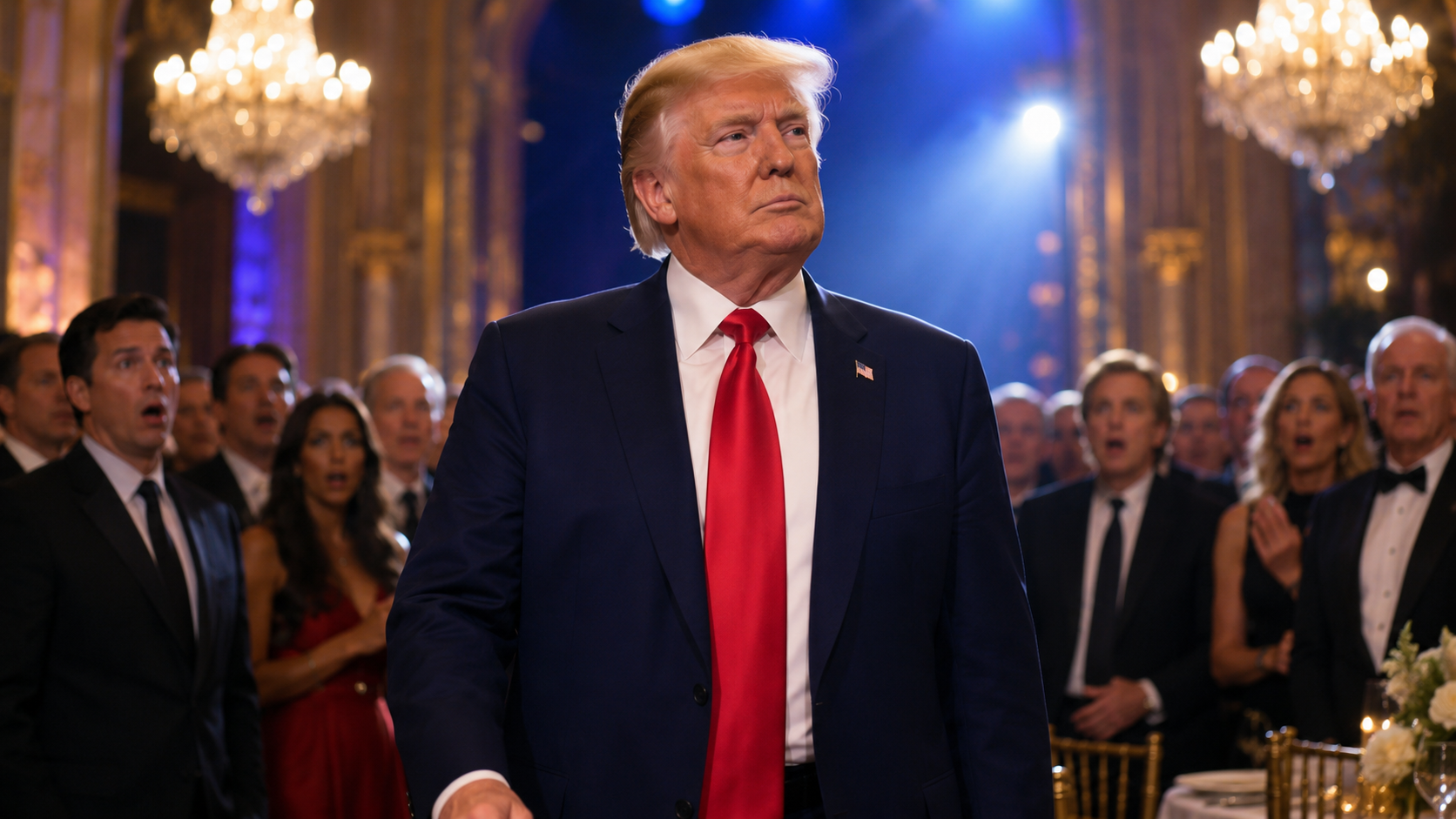
Then the doors opened.
The entire ballroom fell silent.
Every conversation stopped.
Every camera turned.
Donald Trump walked inside.
Alone.
No large entourage.
No announcement.
No music.
Just silence.
He moved calmly through the crowd wearing a dark suit and a red tie, his expression unreadable.
The room seemed frozen.
Some guests exchanged nervous looks.
Others immediately reached for their phones.
The photographers exploded into action.
Flash after flash illuminated the room.
Trump continued walking toward his table without acknowledging the whispers surrounding him.
Several guests who had spent the evening criticizing him suddenly became very interested in their drinks.
Others forced polite smiles.
The host hurried toward the stage microphone.
“Ladies and gentlemen, it appears our final guest has arrived.”
A wave of uncomfortable laughter followed.
Trump sat down.
For several minutes he said nothing.
The event resumed.
Awards were presented.
Speeches were delivered.
Applause filled the room.
Yet everyone’s attention remained fixed on one man sitting quietly near the stage.
Eventually the host smiled toward him.
“Mr. Trump, would you like to say a few words?”
Many expected him to decline.
Instead, he slowly stood.
The room immediately became silent once more.
He walked toward the podium.
For a moment he simply looked around the ballroom.
Faces stared back at him.
Supporters.
Critics.
Old allies.
Former friends.
Journalists waiting for a mistake.
Political opponents hoping for embarrassment.
Trump adjusted the microphone.
“I wasn’t sure I would come tonight.”
The room listened carefully.
“But then I realized something important.”
He paused.
“Sometimes you have to show up personally when everyone else thinks they already know your story.”
A few people shifted uncomfortably in their seats.
“For months, people have spoken for me.”
“They’ve told the public what I think.”
“What I believe.”
“What my future looks like.”
He smiled slightly.
“Tonight I thought perhaps it was finally time to speak for myself.”
The audience remained completely silent.
Then he reached into his jacket pocket.
He removed a small envelope.
Curiosity immediately spread across the room.
Several photographers leaned forward.
Trump placed the envelope on the podium.
“Inside this envelope is the reason I came tonight.”
The room seemed to hold its breath.
“It contains information that only a handful of people in the world currently know.”
Whispers began immediately.
A journalist near the front table typed furiously into his phone.
Another camera flashed.
Trump looked around the room again.
“Before I reveal it, I want to tell you a story.”
The ballroom grew even quieter.
“Many years ago, I learned something important about power.”
“People think power comes from titles.”
“From offices.”
“From buildings.”
“From headlines.”
He shook his head.
“Real power comes from trust.”
“Trust earned over decades.”
“Trust that survives criticism.”
“Trust that survives failure.”
“Trust that survives victory.”
Several guests exchanged glances.
This wasn’t the speech they expected.
Trump continued.
“Over the past year, I met people across the country.”
“Workers.”
“Parents.”
“Veterans.”
“Small business owners.”
“Farmers.”
“They all told me the same thing.”
“They were tired.”
“Tired of anger.”
“Tired of division.”
“Tired of people shouting instead of listening.”
The room remained motionless.
“I listened.”
“And eventually I made a decision.”
He placed his hand on the envelope.
“Tonight I can finally share that decision.”
Several journalists stood from their seats.
The cameras became relentless.
Trump opened the envelope.
He removed a single sheet of paper.
Then he looked directly toward the audience.
“I have spent my entire career building businesses.”
“I have spent years inside politics.”
“But the next chapter of my life will be different.”
The room was absolutely silent.
“I am creating a national foundation dedicated entirely to rebuilding opportunities in forgotten American communities.”
For several seconds nobody reacted.
The audience almost seemed confused.
Trump continued speaking.
“The foundation will invest in vocational training.”
“Scholarships.”
“Veteran housing.”
“Community revitalization projects.”
“Small business funding.”
Many people looked genuinely shocked.
“This initiative has already secured commitments exceeding five billion dollars from private donors and business leaders.”
Gasps spread across the ballroom.
A journalist dropped his pen.
Another stared at him in disbelief.
Trump raised the document.
“The paperwork was finalized this morning.”
Suddenly the room erupted with questions.
“Five billion?”
“Who contributed?”
“When did this happen?”
“Why was this kept secret?”
Trump raised a hand.
The room became quiet again.
“I kept it secret because I wanted the work to matter more than the headlines.”
That sentence seemed to hit the audience harder than anything else he had said all evening.
He continued.
“There will be no political requirements.”
“No party requirements.”
“No ideological tests.”
“If communities need help, they qualify.”
The room remained stunned.
A reporter raised her hand.
“Mr. Trump, are you saying this foundation will operate independently of politics?”
“Yes.”
Another reporter stood.
“Why now?”
Trump smiled.
“Because eventually every person reaches a moment where they ask themselves what they want their legacy to be.”
No cameras flashed during those words.
The room simply listened.
He continued.
“Buildings don’t last forever.”
“Elections don’t last forever.”
“Headlines disappear.”
“But helping people rebuild their lives?”
“That stays.”
Silence followed.
Then applause began somewhere near the back of the ballroom.
One person.
Then another.
Then ten more.
Within seconds the entire room stood.
Even many of his longtime critics joined the applause.
Not because they agreed with him politically.
But because nobody had expected this.
Not tonight.
Not here.
Not from him.
The applause continued for nearly two minutes.
Trump stepped away from the podium.
But the surprises weren’t over.
The host approached him carefully.
“Mr. Trump, may I ask who the first recipient community will be?”
Trump nodded.
“A manufacturing town in Ohio.”
The room listened closely.
“It lost thousands of jobs over the past twenty years.”
“Many families never recovered.”
“Our first project begins there next month.”
Several guests wiped their eyes.
One elderly veteran sitting near the front quietly nodded to himself.
The evening changed completely after that.
The conversations shifted.
Political debates disappeared.
Instead people spoke about possibilities.
About rebuilding towns.
About investment.
About opportunity.
Several business executives privately approached Trump before the night ended.
Each offered support.
Additional funding.
Partnerships.
Resources.
By midnight, the foundation had reportedly gained nearly another billion dollars in commitments.
But the biggest surprise came the next morning.
Headlines across America looked very different from what journalists had expected only hours earlier.
NOT THE SPEECH THEY EXPECTED.
A DIFFERENT KIND OF ANNOUNCEMENT.
THE SECRET THAT CHANGED THE ROOM.
Television panels discussed the foundation nonstop.
Some praised it.
Some questioned it.
Others remained skeptical.
But nearly everyone agreed on one thing.
Nobody had seen it coming.
Three months later, construction crews arrived in Ohio.
Old factories were renovated into training centers.
Vacant buildings became classrooms.
New businesses received startup support.
Families who had planned to leave suddenly reconsidered.
Six months later, similar projects began appearing in Michigan.
Pennsylvania.
West Virginia.
Arizona.
Communities that had spent years feeling forgotten finally saw investment return.
One afternoon, Trump visited one of the first completed centers.
The facility had once been an abandoned warehouse.
Now it contained classrooms, workshops, and technology labs.
A young woman approached him.
“My father lost his job ten years ago.”
Trump listened quietly.
“He thought nobody remembered towns like ours.”
She smiled.
“Now my younger brother is training to become an engineer here.”
For the first time that day, Trump looked genuinely emotional.
He thanked her quietly.
As he prepared to leave, an older man stopped him near the entrance.
The man wore a military veteran cap.
“I didn’t vote for you,” the veteran said.
The security team became tense.
Trump simply smiled.
The veteran continued.
“But this place gave my grandson a second chance.”
He extended his hand.
“That’s more important than politics.”
Trump shook his hand.
“No disagreement there.”
News of the exchange spread quickly online.
Millions watched the video.
Millions shared it.
For many people, it became the symbol of the entire project.
Not politics.
Not elections.
People.
Months became years.
The foundation expanded further than anyone expected.
Scholarship programs grew.
Housing projects expanded.
Vocational centers opened in dozens of cities.
Some projects succeeded immediately.
Others struggled.
But the effort continued.
One evening, nearly three years after the gala, another event took place in the same ballroom in Washington.
The same chandeliers.
The same marble floors.
The same stage.
Many of the same journalists attended.
So did many of the same politicians.
The host stepped onto the stage.
“Ladies and gentlemen, tonight we celebrate the third anniversary of the American Renewal Initiative.”
Applause filled the room.
Statistics appeared on giant screens.
Thousands of scholarships awarded.
Hundreds of businesses funded.
Thousands of jobs created.
Entire neighborhoods revitalized.
The audience applauded repeatedly.
Then the host smiled.
“There is one person we would like to invite back to this stage.”
Everyone already knew who it would be.
Trump walked toward the podium once more.
This time the room stood before he even spoke.
He looked around the ballroom.
Three years earlier these same faces had expected a very different speech.
A very different secret.
A very different ending.
Trump smiled.
“Funny how life works.”
Laughter spread gently through the room.
“The night I walked through those doors, many people thought they knew why I came.”
He looked toward the audience.
“Turns out I surprised myself too.”
The room laughed again.
He continued.
“I learned something important over the last three years.”
“People are capable of working together more often than we think.”
“We simply don’t give them enough opportunities.”
Applause followed.
He looked toward a table near the front.
Several scholarship recipients sat there.
Veterans.
Small business owners.
Students.
Workers.
Families.
Real people whose lives had changed because of a decision announced in that room years earlier.
Trump smiled.
“This was never my project.”
“It belongs to all of you now.”
The audience stood again.
This time the applause lasted even longer.
As the evening ended, reporters gathered outside beneath the lights of television cameras.
One journalist asked the question everyone wanted answered.
“Looking back, what do you think was the real secret you brought into that room three years ago?”
Trump paused for a moment.
Then he answered.
“Hope.”
The reporter looked surprised.
Trump continued.
“People expected another political announcement.”
“They expected another fight.”
“Another battle.”
“What they got instead was hope.”
He smiled.
“And honestly, I think the country needed that more.”
He walked toward his car as cameras continued flashing around him.
The journalist watched him leave.
Then she looked down at her notes.
Not once during the interview had he mentioned elections.
Or opponents.
Or victories.
Only communities.
Families.
Opportunities.
Hope.
Sometimes the biggest surprises are not scandals.
Not secrets.
Not victories.
Sometimes the biggest surprise is discovering that people are capable of becoming something different from what the world expects.
And sometimes all it takes is one person walking through a door everyone believed would remain closed.
Years later, people would still remember that evening.
Not because of politics.
Not because of controversy.
Not because of headlines.
They remembered it because an entire room full of people expected conflict—
and instead witnessed purpose.
That was the secret that stunned everyone in the room.
And in the end, it became something far greater than a secret.
It became a legacy.