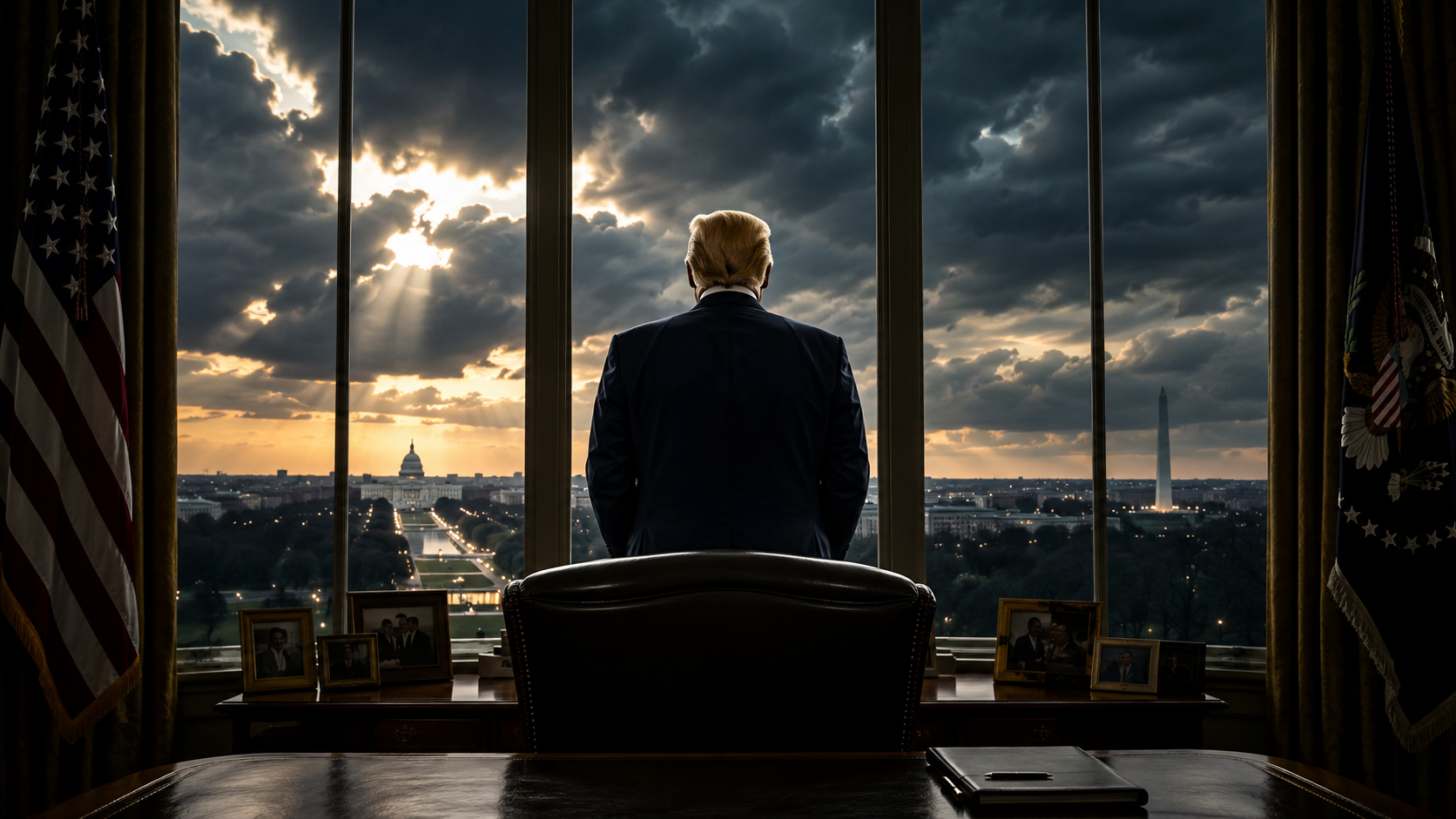
The rain began falling over Washington long before dawn.
Inside the White House, the atmosphere was heavier than the storm clouds gathering above the city. Staff members moved quickly through the corridors, their footsteps echoing against marble floors polished by generations of history.
At precisely 7:00 a.m., President Donald Trump entered the Cabinet Room.
The meeting had been scheduled weeks earlier.
Officially, it was a routine national security briefing.
Unofficially, everyone in the room knew something was wrong.
Vice presidents, senior advisors, military officials, and intelligence directors filled their seats around the long wooden table.
No one spoke.
Not until the President sat down.
Donald Trump glanced around the room.
Every face looked tense.
Too tense.
He folded his hands together.
“Alright,” he said. “Let’s hear it.”
The Director of National Intelligence slid a folder across the table.
It was marked:
CONFIDENTIAL.
Trump opened it.
Inside were satellite images, financial reports, encrypted communications, and intelligence summaries from agencies around the world.
He flipped through the pages silently.
Then he stopped.
Page seventeen.
His expression changed.
No one in the room missed it.
“What is this?” Trump asked quietly.
The intelligence director swallowed.
“Sir… we only received confirmation last night.”
Trump looked back at the page.
A single sentence was highlighted.
Operation Liberty Shield has been compromised.
The room remained silent.
For the first time during the meeting, Trump leaned back in his chair.
“Who knows about this?”
“Only the people in this room.”
“And how long have they known?”
“Approximately twelve hours.”
Trump closed the folder.
The room expected questions.
Instead, he stood up.
The President looked toward the windows overlooking the South Lawn.
Then he spoke.
“We’ll continue this later.”
Several officials exchanged confused looks.
“Mr. President?” one advisor asked.
Trump shook his head.
“Meeting adjourned.”
Without another word, he walked out.
The heavy doors closed behind him.
The room erupted immediately.
“What’s happening?”
“Where is he going?”
“Did he know something we don’t?”
No one had answers.
Not even his closest advisors.
Two hours later, Trump’s motorcade arrived at a secure government archive facility outside Washington.
Few people even knew the building existed.
No signs marked the entrance.
No public records listed its address.
The guards recognized the presidential seal immediately.
Within minutes, Trump was escorted underground.
Three floors below the surface, an elderly archivist waited beside a steel vault door.
His name was Samuel Mercer.
He had worked for four presidents.
He had never been summoned directly by the President himself.
Until now.
Trump approached him.
“I need file 47-A.”
Mercer’s eyes widened.
“Sir… that file is restricted.”
“I know.”
“It requires authorization from—”
“I am the authorization.”
Mercer hesitated.
Then nodded.
Ten minutes later, the vault opened.
Inside sat rows of documents sealed in climate-controlled containers.
Mercer carefully removed a black case.
He placed it on the table.
Trump opened it.
Inside was a document dated twenty-three years earlier.
He read the first paragraph.
Then the second.
By the third page, the room felt colder.
Mercer watched silently.
Finally, Trump looked up.
“How many copies exist?”
“One.”
“Who else knows?”
Mercer answered immediately.
“No one.”
Trump closed the case.
“Good.”
That afternoon, rumors spread through Washington.
Why had the President ended the meeting early?
Why had his schedule suddenly disappeared from public records?
Why had military aircraft changed routes over the Atlantic?
News channels speculated endlessly.
No one came close to the truth.
Because the truth was stranger than anyone imagined.
The document wasn’t about war.
It wasn’t about elections.
It wasn’t about foreign governments.
It was about a financial network hidden inside the global economy for decades.
A network operating beyond politics.
Beyond administrations.
Beyond borders.
According to the files, billions of dollars had disappeared over thirty years.
The money moved through shell corporations, private foundations, and offshore accounts spread across dozens of countries.
Every investigation had failed.
Every trail ended.
Until now.
One name appeared repeatedly.
A codename.
JANUS.
No identity.
No photograph.
No nationality.
Only transactions.
Billions of dollars moving silently through the system.
The intelligence community believed JANUS controlled influence operations in multiple nations.
Governments changed.
Presidents came and went.
JANUS remained.
Trump stared at the pages.
One detail caught his attention.
The most recent transaction had occurred forty-eight hours earlier.
Destination:
Washington, D.C.
That evening, Trump called only three people.
The Secretary of Treasury.
The Director of National Intelligence.
And retired federal investigator Marcus Hale.
Hale arrived at the White House shortly after sunset.
He had retired seven years earlier.
He never expected another call.
Especially not from the President.
Trump met him personally.
“No cameras.”
“No staff.”
“No records.”
Hale nodded.
Trump handed him the file.
The investigator spent nearly an hour reading.
When he finished, he looked up slowly.
“This can’t be real.”
Trump leaned back.
“You think it’s fake?”
“No.”
Hale looked toward the window.
“I think it’s worse.”
Over the next seventy-two hours, a secret task force formed quietly.
No announcements.
No press conferences.
Only six people knew it existed.
Every lead pointed somewhere different.
Banks.
Investment firms.
Political organizations.
Technology companies.
The deeper they dug, the stranger the pattern became.
Every trail eventually circled back to one building in New York.
An office tower with fewer than thirty employees.
Officially, it was a consulting company.
Unofficially, it existed only on paper.
Trump studied photographs of the building.
“Send a team.”
Hale shook his head.
“They’ll disappear before we arrive.”
“How do you know?”
“Because they’ve done it before.”
Trump stared at him.
“You’ve seen this?”
Hale nodded slowly.
“In 2009.”
“What happened?”
“We got close.”
“And?”
Hale looked away.
“The investigation vanished.”
“Vanished?”
“Files disappeared.”
“Witnesses disappeared.”
“Careers disappeared.”
The room fell silent.
Three days later, everything changed.
At 2:17 a.m., a courier arrived at the White House.
No return address.
No identification.
Only a sealed envelope.
Inside was a flash drive.
Attached was a handwritten note.
You’re looking in the wrong direction.
Trump inserted the drive into an isolated computer system.
A video appeared.
A man sat in darkness.
His face hidden.
His voice distorted.
“If you’re watching this, then you’ve found JANUS.”
Trump leaned closer.
The man continued.
“But JANUS is not a person.”
The President frowned.
“It’s an organization.”
The screen filled with names.
Executives.
Officials.
Investors.
Lobbyists.
Some were famous.
Others completely unknown.
Together they formed a network larger than anyone imagined.
The video ended with one final sentence.
Trust no one.
Washington exploded into chaos behind closed doors.
Who could be trusted?
Who couldn’t?
Every agency began reviewing personnel records.
Financial histories.
Communications.
Nothing looked unusual.
That was the frightening part.
The organization had hidden perfectly for decades.
Trump held another private meeting.
This time only four chairs surrounded the table.
“No leaks,” he said.
“No politics.”
“No agendas.”
“Only facts.”
The investigation continued.
Then came the breakthrough.
A transfer.
Thirty-seven million dollars.
Scheduled for midnight.
Destination unknown.
Hale smiled for the first time in days.
“We found them.”
Federal analysts tracked the transaction across international banking systems.
Switzerland.
Singapore.
Dubai.
London.
Then suddenly—
Washington.
The money stopped moving.
Account holder:
Liberty Foundation Holdings.
Trump looked confused.
“Never heard of them.”
Neither had anyone else.
The company didn’t exist six months earlier.
Its office address belonged to an abandoned warehouse.
Its employees didn’t exist.
Its tax filings were perfect.
Too perfect.
Hale closed the file.
“This is it.”
The warehouse operation began before sunrise.
Agents entered quietly.
No resistance.
No guards.
Only computers.
Servers.
Documents.
Thousands of documents.
One agent called out.
“Sir, you need to see this.”
Hale walked over.
The wall was covered with photographs.
Politicians.
Business leaders.
Foreign officials.
Media executives.
Connected by red strings.
At the center stood one word.
JANUS.
Below it:
Influence is more powerful than power itself.
Hale photographed everything.
Trump received the images minutes later.
He stared at them silently.
Then his phone rang.
Unknown number.
He answered.
A voice spoke calmly.
“Mr. President.”
Trump remained silent.
“You’ve opened a door that should have stayed closed.”
“Who is this?”
“Someone trying to help you.”
“Help me?”
“Walk away.”
Trump smiled slightly.
“That’s not happening.”
The line disconnected.
By now, pressure surrounded the White House.
Journalists demanded explanations.
Congress demanded answers.
Foreign governments requested meetings.
The President said nothing.
Not yet.
Because the final piece still remained missing.
The original document.
The one hidden in archive file 47-A.
Trump returned to the underground vault.
Samuel Mercer waited beside the door.
“You came back.”
Trump nodded.
“I missed something.”
Mercer handed him the file.
The President read every page carefully.
Then he saw it.
A signature.
Not a name.
Only initials.
D.T.
Trump stared at them.
Impossible.
Mercer spoke quietly.
“Those initials don’t belong to you.”
Trump looked up.
“Then who?”
Mercer opened another folder.
Inside sat a photograph from 1983.
A businessman stood beside several international investors.
One man had his face circled in red.
His name:
Daniel Thornton.
An economist who disappeared in 1991.
The initials matched.
D.T.
Thornton had discovered JANUS decades earlier.
Before he could expose it—
he vanished.
The file had been buried ever since.
Until now.
Trump looked at the photograph.
“What happened to him?”
Mercer answered softly.
“No one knows.”
The President nodded.
“Then let’s find out.”
Three days later they did.
Daniel Thornton was alive.
Eighty-one years old.
Living quietly in Montana under a different identity.
When agents arrived, he wasn’t surprised.
“I wondered when someone would come.”
Thornton traveled to Washington immediately.
Trump met him privately.
The elderly economist looked tired.
But his eyes remained sharp.
“I tried to stop them,” Thornton said.
“What happened?”
“They were everywhere.”
“Governments?”
“No.”
“Businesses?”
“Some.”
“Then who?”
Thornton leaned forward.
“People who understood one thing.”
“What?”
“Control information, and eventually you control everything.”
For six hours Thornton explained everything.
The rise of hidden influence networks.
Economic manipulation.
Media campaigns.
Political pressure.
None of it involved secret armies.
None involved science fiction conspiracies.
Only money.
Influence.
Access.
The oldest forms of power.
Trump listened carefully.
Finally he asked the question everyone feared.
“Can they be stopped?”
Thornton smiled slightly.
“Yes.”
“How?”
“Sunlight.”
The following week, the President addressed the nation.
Millions watched.
Cameras rolled.
The room stood silent.
Trump stepped behind the podium.
“My fellow Americans,” he began.
“Today I want to speak not about politics, but about transparency.”
He spoke about accountability.
Financial integrity.
Public trust.
He announced reforms.
International cooperation agreements.
New oversight measures.
Stronger reporting standards.
He never mentioned JANUS by name.
He didn’t have to.
Because the message was clear.
The age of shadows was ending.
Months passed.
Investigations continued worldwide.
Billions in hidden assets were recovered.
Dozens of cases reopened.
Governments cooperated in ways few thought possible.
The headlines called it historic.
The public never learned the entire story.
Some secrets remained classified.
Some names remained hidden.
Some files remained locked away.
But one thing changed forever.
People began asking questions again.
Demanding answers again.
Expecting transparency again.
And sometimes that alone changes history.
Late one evening, Trump stood alone outside the White House.
The city lights stretched across Washington.
Behind him, aides prepared for another busy day.
Ahead of him lay uncertainty.
Politics would continue.
Arguments would continue.
Elections would continue.
But somewhere deep beneath a secure archive facility, file 47-A remained sealed once more.
Only now, a new sentence had been added to the cover page.
Opened July 1.
Closed July 28.
Status:
Investigation ongoing.
Trump looked toward the horizon.
History had a strange habit of repeating itself.
Unless someone chose to interrupt it.
This time, someone had.
And somewhere in America, Daniel Thornton watched the evening news from his quiet ranch in Montana.
He smiled.
For thirty-five years he had carried the weight alone.
Now the truth belonged to history.
The storm clouds over Washington had finally begun to clear.
But everyone involved understood the same reality.
Secrets never disappear.
They only wait.
Waiting for the right document.
Waiting for the right moment.
Waiting for someone willing to open the file.
And sometimes—
everything changes the moment they do.
PART 2: The Last Member of JANUS
Three months had passed since the investigation officially ended.
At least, that was what the public believed.
The headlines had moved on.
Markets recovered.
Governments returned to normal business.
Television networks stopped discussing hidden financial networks and secret influence organizations.
Officially, JANUS no longer existed.
Unofficially—
President Donald Trump knew better.
The secure folder remained locked inside a classified archive beneath Washington.
Every few weeks new information arrived.
Small fragments.
Missing transfers.
Dormant bank accounts suddenly activated.
Encrypted communications with no identifiable source.
Someone was still out there.
Someone who had survived.
Someone who had learned how to remain invisible.
One rainy evening inside the White House residence, Trump sat alone reviewing intelligence summaries when his secure phone rang.
Only six people in the world possessed that number.
He answered immediately.
“Mr. President,” Marcus Hale said.
His voice sounded different.
More serious than usual.
“We found something.”
Trump stood.
“What is it?”
“A payment.”
“Another one?”
“No.”
Hale paused.
“This one came from Washington.”
Trump remained silent.
“Destination?”
“Unknown.”
“Amount?”
“One dollar.”
Trump frowned.
“One dollar?”
“Exactly one dollar.”
“That makes no sense.”
“It does if it’s a signal.”
The room suddenly felt colder.
Trump understood immediately.
Someone wasn’t transferring money.
Someone was sending a message.
JANUS was alive.
And it was close.
Very close.
The investigation restarted before sunrise.
No announcements.
No official orders.
Only four people were informed.
Marcus Hale.
The Director of National Intelligence.
Treasury Secretary Rebecca Collins.
And the President.
The transaction had passed through seven banks in four countries before arriving in Washington.
Its final destination was a local account opened eighteen years earlier.
The account holder’s name shocked everyone.
Thomas Avery.
Age seventy-three.
Occupation:
Archivist.
Trump looked up immediately.
“Samuel Mercer.”
Hale nodded.
“The name was fake.”
The President stared at the report.
The elderly archivist who had guarded file 47-A.
The quiet man who had spent decades protecting classified documents.
The man who claimed nobody else knew about JANUS.
Trump slowly closed the folder.
“He was right beside us.”
By evening, agents arrived at Mercer’s apartment.
The door was unlocked.
Inside they found coffee still warm on the table.
The television remained on.
A chess board sat unfinished near the window.
But Samuel Mercer was gone.
On the kitchen counter rested a single envelope.
Inside was one sentence.
You were always meant to find me.
Signed:
JANUS.
For the first time in decades, Marcus Hale looked afraid.
“He’s not running.”
Trump looked at him.
“Then what’s he doing?”
“Waiting.”
“Why?”
Hale stared out the window toward the Capitol skyline.
“Because he wants something.”
Three hours later they discovered what it was.
Mercer’s fingerprints appeared inside the National Archives building.
Security footage showed him entering shortly after midnight.
He walked directly toward a storage room that contained historical presidential correspondence.
He stayed exactly twelve minutes.
Then disappeared.
Nothing appeared stolen.
Nothing appeared moved.
Until investigators examined shelf B-14.
One document was missing.
Only one.
A sealed letter written in 1963.
Recipient:
Future Presidents of the United States.
Author:
Unknown.
Washington erupted behind closed doors.
No one understood the letter.
No records mentioned it.
No inventory logs described its contents.
Officially, the letter never existed.
Trump held the empty archive box in silence.
“Find him.”
Agents searched airports.
Train stations.
Bus terminals.
Nothing.
Samuel Mercer had vanished as completely as Daniel Thornton decades earlier.
Then the breakthrough came.
At 2:11 a.m., a camera near the Lincoln Memorial captured an image.
An elderly man standing alone beside the reflecting pool.
Waiting.
Marcus Hale recognized him instantly.
They arrived twelve minutes later.
Mercer remained standing exactly where the camera had captured him.
He did not run.
He did not resist.
Instead, he smiled.
“I wondered how long it would take.”
Trump stepped forward.
“Who are you?”
The old man looked toward the Washington Monument.
“My real name is Thomas Avery.”
“You’re JANUS?”
He shook his head.
“No.”
“Then what are you?”
“The last witness.”
They moved the conversation to a secure location beneath the White House.
For three hours Avery spoke.
No interruptions.
No recordings.
No reporters.
Only history.
JANUS, he explained, had never been an organization in the traditional sense.
There were no memberships.
No headquarters.
No leaders.
Only custodians.
People chosen to preserve influence across generations.
When one died, another replaced them.
For decades Avery had watched governments rise and fall.
Presidents came and went.
Wars began and ended.
His responsibility remained unchanged.
Observe.
Protect stability.
Intervene only when necessary.
Trump leaned forward.
“Then why reveal yourself now?”
Avery smiled sadly.
“Because my generation failed.”
The room fell silent.
“The world deserves transparency.”
Marcus Hale crossed his arms.
“So why steal the letter?”
Avery slowly removed an envelope from his coat pocket.
“I didn’t steal it.”
He placed it on the table.
“I brought it to you.”
Trump opened the envelope carefully.
Inside was a single handwritten page.
No signature.
No date.
Only one paragraph.
Power survives because people fear asking questions.
The day citizens stop questioning authority is the day freedom begins to disappear.
Protect disagreement.
Protect transparency.
Protect truth.
Because nations are not destroyed by enemies outside their borders.
They disappear when people inside stop caring enough to defend them.
The room remained silent.
Trump read the words twice.
Then a third time.
Finally he looked up.
“Who wrote this?”
Avery answered quietly.
“I promised I would never say.”
News of Avery’s existence never became public.
Neither did the letter.
Official reports described him as a retired archivist assisting historical investigations.
The world moved forward.
Markets opened.
Governments changed.
Elections continued.
Life carried on.
But deep inside Washington, one final JANUS file remained sealed.
Its cover page contained only four words:
THE LAST CUSTODIAN.
Months later, Trump returned to the archive alone.
He looked at the file for several moments before closing the vault.
Some secrets belonged to history.
Others belonged to the future.
As he walked away, he remembered Avery’s final words.
“Organizations die.”
“Ideas don’t.”
Outside, the lights of Washington stretched across the horizon.
For the first time in many months, the city felt quiet.
Peaceful.
Yet somewhere beneath that silence remained an uncomfortable truth.
The greatest danger had never been JANUS.
The greatest danger was forgetting why transparency mattered in the first place.
Trump stepped into the night air and looked toward the Capitol.
The storm had passed.
The shadows had faded.
And for now—
the final member of JANUS was gone.
END.