The Stranger at the Curb
The late August heat had baked the suburban streets of Oak Creek into a shimmering, mirage-laden quiet. The air was thick and stagnant, smelling faintly of hot asphalt and cut grass. I was standing on my front porch, wiping sweat from my forehead, when the sleek, charcoal-gray moving truck rolled to a halt in the driveway of the vacant house next door.
The property had been empty for nearly two years. The lawn had surrendered to dandelions, and the paint on the siding was peeling like a severe sunburn. I watched with mild curiosity as the driver’s side door swung open and a man stepped out into the sweltering afternoon.
He didn’t look like someone prepared for heavy lifting. He wore a crisp, dark navy suit that looked completely untouched by the oppressive humidity. He was tall, with sharp, angular features, pale skin, and dark hair swept neatly back. He possessed a rigid, almost aristocratic posture.
He caught me staring. Instead of offering the polite, tight-lipped nod of a new neighbor, his face broke into a wide, radiant smile. He didn’t head for the back of the truck. He walked directly across the property line, stepping over the overgrown crabgrass, and headed straight for my porch.
“You must be Elias,” he said, stopping at the bottom of my steps. His voice was smooth, resonant, and unnervingly calm.
“Yeah, that’s me,” I said, shifting my weight defensively. “Do I know you?”
He stepped up onto the first step, extending a pale, long-fingered hand. “Not yet. But I certainly know you. I’m Julian.”
I shook his hand. His skin was ice-cold, sending a bizarre jolt up my arm.
Julian’s smile deepened into something that felt profoundly intimate, a look of immense gratitude that you reserve for family. “I just wanted to come over immediately and thank you. For saving my life ten years ago.”
I froze. A nervous chuckle escaped my throat as my brain scrambled to process the statement. I scanned my memories, looking for a drowning incident, a car wreck, a moment of teenage heroism. There was nothing. Ten years ago, I was seventeen. I spent that summer failing AP Physics and playing video games in my basement.
“I think you have the wrong guy, Julian,” I said, taking a subtle step back. “I’ve never saved anyone’s life. And no offense, but I’ve never met you before.”
Julian didn’t blink. He just kept smiling like we were old friends.
“You don’t remember the act, Elias, because you didn’t know what you were doing at the time,” Julian said softly. “But I remember. I remember everything about you. I remember your sanctuary.”
Then, his voice dropping to a hypnotic cadence, he described my childhood bedroom perfectly.
“Second floor, east-facing window,” Julian murmured. “The wallpaper was a faded nautical theme—ships and compasses—but you covered most of it with sketchpads. You had a crack in the drywall right above your closet door that looked exactly like a jagged lightning bolt. Your floorboards creaked in three specific places: by the desk, under the window, and right in front of the radiator where you hid a small, locked cedar box. And the radiator itself… it leaked just enough to warp the baseboard in the corner.”
The breath vanished from my lungs. The oppressive heat of the afternoon suddenly felt freezing.
He was describing the house I grew up in, located in a remote, heavily wooded town three hundred miles away from Oak Creek. We had moved out of that house abruptly when I turned eighteen, and it had been sold to a developer who bulldozed it to build a subdivision.
“How do you know that?” I whispered, my voice trembling. “Who the hell are you?”
Julian’s smile softened into something almost sympathetic. “Like I said, Elias. I’m your new neighbor. We’ll have plenty of time to catch up.”
He turned and walked back toward his moving truck, leaving me paralyzed on the porch.
Chapter 2: The Locked Door
I stumbled back into my house, slamming the front door and locking the deadbolt. My hands were shaking so violently I could barely slide the screen of my phone to unlock it.
It was impossible. The details he possessed weren’t the kind of things you could find on the internet. Nobody takes photos of warped baseboards or creaky floorboards. That cedar box had been my absolute most guarded secret—a place where I kept my journals and cash. No one knew about it.
I scrolled through my contacts and hit the dial button for my parents. They had retired to Florida two years ago, living a quiet, isolated life. My mother answered on the fourth ring.
“Elias? Honey, everything okay? You never call on a Tuesday.”
“Mom, I need you to answer a question for me, and I need you to think really hard before you do,” I said, my voice tight and breathless.
“Alright… you’re scaring me. What is it?”
“When we lived in the house on Blackwood Lane… did we ever have contractors upstairs? A painter? A house sitter? Did you or Dad ever let anyone stay in my room when I was away at summer camp?”
There was a long, heavy silence on the line. I could hear the faint sound of seagulls in the background.
“Why on earth are you asking about that old house?” she asked, her voice losing its warmth. It sounded suddenly guarded, almost defensive.
“Because a man just moved in next door to me,” I paced into my kitchen, peeking through the blinds at the charcoal moving truck outside. “He knew what my room looked like. He described the nautical wallpaper, the crack in the wall, the warped baseboards. Mom, who did you let into my room?”
I heard her sharply inhale. “Elias, I swear to you. We swore no one outside the family had ever been inside that house. Your father was obsessive about our privacy, you know that. No contractors. No house sitters. No one.”
“Then how does he know?!” I shouted, the panic finally breaking through.
“I don’t know, Elias, but you need to listen to me,” she said, her voice dropping to a frantic whisper. “Stay away from him. Do not go near that man. I’m going to get your father—”
The line clicked and went dead.
I stared at the screen. I tried calling back, but it went straight to a generic voicemail. A profound, suffocating paranoia set in. My mother hadn’t sounded confused; she had sounded terrified.
Chapter 3: The Heavy Metal
I spent the next three hours locked in my house, watching the new neighbor through the slits in my blinds. The sun began to set, casting long, bruised shadows across the lawns.
Julian worked entirely alone. He didn’t unload couches, televisions, or mattresses from the truck. Instead, he unloaded heavy, reinforced steel crates. He moved with a frightening, mechanical efficiency, carrying crates that should have required a forklift as if they weighed nothing at all.
By 8:00 PM, the truck was empty. The streetlights flickered on, buzzing with a dull, electrical hum.
Suddenly, a sharp, rhythmic knock echoed through my house.
Knock. Knock. Knock.
I crept to the front door and looked through the peephole. Julian stood on my porch. He had removed his suit jacket, revealing a crisp white shirt, but he didn’t look like he had just spent three hours doing manual labor in ninety-degree heat. He wasn’t sweating.
I kept the heavy chain engaged and opened the door a fraction of an inch. “What do you want?”
“I just wanted to say goodnight, Elias,” Julian said smoothly. “And to give you something. A token of my appreciation. A reminder of our shared history.”
He reached his pale hand through the narrow crack in the door. Resting in his palm was a heavy, antique piece of metal.
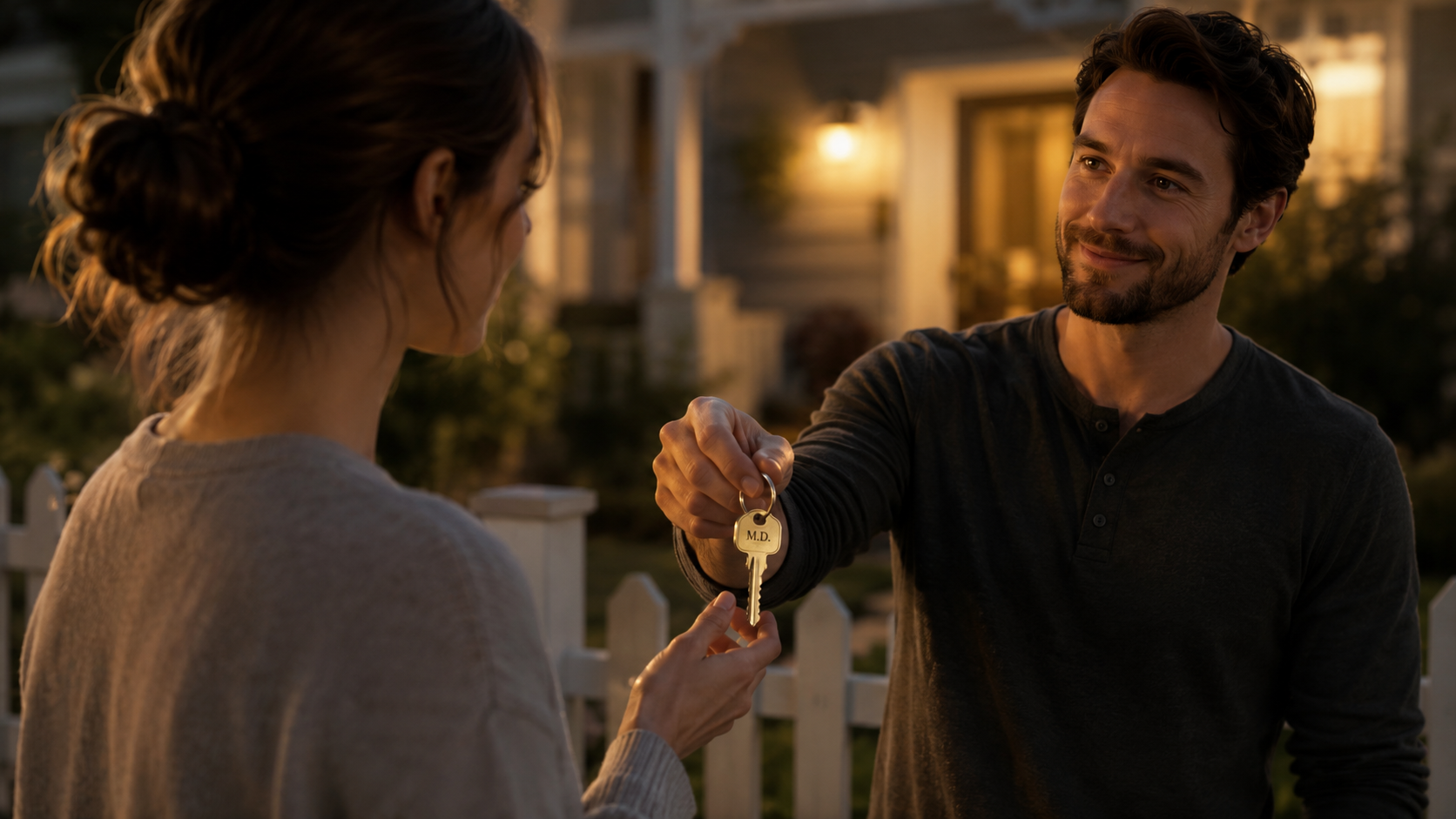
Before leaving, he handed me a key with my initials engraved on it.
I stared at it. It was a skeleton key, forged from dark, blackened iron. The bow of the key was shaped like a twisted root system, and stamped directly into the center of the metal were two letters: E.V.
My initials. Elias Vance.
My breath caught in my throat. I reached out with a trembling hand and took the cold iron from his palm. The moment my skin touched the metal, a violent, visceral memory slammed into my conscious mind.
“Have a good evening, neighbor,” Julian whispered. He turned and walked away into the dark.
I shut the door, slid down the wood paneling, and sat on the floor of my foyer, staring at the iron key in my hand.
I had seen that key only once before.
Chapter 4: Ten Years Ago
The memory was locked away, buried deep beneath years of willful suppression and teenage trauma. But the weight of the iron key dragged it kicking and screaming to the surface.
It was the summer I was seventeen. We lived at the end of Blackwood Lane, surrounded by dense, suffocating acres of pine forest. My father was a strict, terrifyingly private man. He was a bio-engineer for a pharmaceutical company, though he never talked about his work. He had one absolute rule in our house: Never go into the sub-basement.
He kept the door in the hallway padlocked. He claimed the foundation down there was rotting and dangerous.
But one night in mid-July, my parents left for an emergency overnight trip to the city. I was left alone in the house. Driven by the invincible, stupid curiosity of a teenager, I decided to explore. I found a spare set of keys hidden in a false bottom of my father’s desk drawer.
I unlocked the sub-basement door and descended the wooden stairs, a flashlight clutched in my sweating hand.
The sub-basement wasn’t rotting. It was pristine. The walls were reinforced with thick concrete, and the air was freezing cold, smelling sharply of ozone and medical antiseptic.
At the far end of the room was a heavy, solid steel door, reminiscent of a bank vault. Next to the door was a metal table. Resting on that table was this exact iron key, with the letters E.V. engraved into it.
I had picked up the key. It felt heavy and wrong. I approached the steel door. There was a small, sliding viewing grate at eye level. My hand trembling, I slid the metal grate open and shined my flashlight into the pitch-black room beyond.
What I saw had haunted my nightmares for a decade.
It was a small, concrete cell. Sitting in the center of the floor, chained to the wall by a thick iron shackle, was a boy. He looked to be exactly my age. He was emaciated, his skin pale and translucent, his dark hair matted with sweat.
But it was his face that broke my mind.
The boy looked exactly like me. Not similar. Identical. Like looking into a cracked, terrifying mirror.
The beam of my flashlight hit his face. The boy’s eyes snapped open. They weren’t human eyes. They were entirely black, devoid of irises or whites, like twin pools of ink.
He lunged toward the door, the chain pulling taut with a sickening crack.
I screamed, dropping the flashlight. I dropped the iron key on the floor. In a state of absolute, blind panic, I didn’t bother to close the viewing grate. I turned and sprinted up the stairs, slammed the sub-basement door, locked it, and hid in my bedroom under the covers until my parents came home the next morning.
I never told them what I saw. I convinced myself it was a hallucination, a fever dream brought on by the summer heat and a vivid imagination. A few months later, my father abruptly announced we were moving. The house was demolished. The secret was buried.
Until tonight.
Chapter 5: The Reflection
I sat on the floor of my foyer, the puzzle pieces clicking together with a horrifying finality.
He described my bedroom perfectly.
We swore no one outside the family had ever been inside that house.
Because he wasn’t outside the family. And he hadn’t been inside my bedroom. He had been directly underneath it.
I gripped the key tightly and stood up. The fear that had been paralyzing me suddenly mutated into a desperate, burning need for the truth. I threw open my front door and marched across the damp lawn toward the house next door.
The front door was wide open, as if he had been expecting me.
I stepped into the dark foyer. The house was dead quiet. “Julian!” I yelled, my voice echoing off the bare drywall. “Where are you?!”
“In the kitchen, Elias,” his smooth voice drifted down the hall.
I walked down the corridor and stepped into the kitchen. Julian was sitting at a small folding table. A single, bare lightbulb hung from the ceiling, casting harsh shadows across his face. He looked older than the boy I had seen in the basement, his features sharper, but the resemblance was undeniable. He was a dark, twisted reflection of myself.
“Who are you?” I demanded, holding up the iron key. “What is this?”
Julian gestured to the empty chair across from him. “Sit down, brother.”
I flinched at the word. “I don’t have a brother.”
“You did,” Julian said, his voice laced with a cold, ancient bitterness. “We were twins, Elias. Born on the same day, under the same roof. But I wasn’t… perfect. Our father, the brilliant bio-engineer, noticed the anomalies early on. My blood didn’t clot right. My eyes didn’t react to light the way they were supposed to. I was a genetic mutation. A stain on his pristine legacy.”
He leaned forward, the shadows dancing across his pale skin. “He didn’t want to kill me. He wasn’t a monster in that regard. But he couldn’t let the world see me. So, he built the sub-basement. He told everyone I died of SIDS. And he locked me in the dark for seventeen years.”
A wave of nausea washed over me. I grabbed the edge of the table to steady myself. “My parents… they kept you in a cage?”
“Like an animal,” Julian nodded slowly. “They fed me scraps. They ran tests. And the whole time, I sat in the dark and listened to you live my life. I heard you running up and down the stairs. I heard you playing video games. I memorized the creak of every floorboard in your bedroom above my head. I knew where you hid your cedar box because I could hear you pacing in front of the radiator.”
“I didn’t know,” I whispered, tears stinging my eyes. “Julian, I swear to God, I didn’t know you existed until that night.”
Julian’s eyes softened, a genuine warmth returning to his face. “I know, Elias. And that’s why I’m here. Because of that night.”
Chapter 6: The Debt
“When you opened that viewing grate,” Julian said, his voice dropping to a reverent whisper, “you gave me the one thing our father had denied me for seventeen years. You gave me light. You dropped your flashlight on the floor, and its beam shone directly onto the padlock of my chain. And more importantly… you dropped the key.”
I stared at him, the realization dawning on me.
“You ran away,” Julian continued. “But the key was right outside the bars of the grate. I reached through. I stretched my arm until the joint popped, and I dragged that key into the cell. I unlocked my chain. I waited until your parents came home, and when our father came down to check on me, I ambushed him.”
A sickening chill crawled up my spine. “What did you do to him?”
“I didn’t kill him,” Julian said coldly. “I simply showed him how strong the mutation had made me. I broke his leg, I took his wallet, and I walked out the back door into the woods. I disappeared. They demolished the house to hide the evidence of what they had built down there. They fled to Florida to hide from me.”
He reached across the table and placed his cold hand over mine.
“You saved my life, Elias. If you hadn’t opened that door, if you hadn’t dropped that key, I would have died in that concrete box. I owe you my freedom. I owe you everything.”
I pulled my hand away, my chest heaving. “Then why are you here? If you’re free, why move in next door to me ten years later? What do you want?”
Julian’s expression darkened. The warmth vanished, replaced by a terrifying, lethal seriousness.
“I’m not here for you, Elias,” he said quietly. “I’m here to protect you. From them.”
“From my parents?” I scoffed, though the fear in my stomach was twisting into a knot. “They’re retired in Florida. They’re old.”
Julian stood up from the table. He walked over to one of the heavy steel crates he had carried into the house earlier. He popped the latches and threw open the lid.
Inside the crate wasn’t furniture. It was an arsenal. Tactical vests, encrypted communication gear, and high-grade military weaponry.
“Our father didn’t retire, Elias,” Julian said, pulling a heavy, matte-black rifle from the crate. “He relocated his research. And three days ago, I intercepted a communication from his private server. He knows I’m still alive. He knows I’ve been tracking him. But he also knows he can’t get to me directly.”
Julian turned back to face me, his black eyes boring into my soul.
“He’s tying up loose ends, Elias. He realizes that as long as you’re alive, there’s a chance I might contact you. A chance you might find out the truth about the family. And a man like our father doesn’t leave loose ends.”
My phone suddenly buzzed in my pocket, shattering the silence of the kitchen.
I pulled it out. The caller ID flashed on the screen: MOM.
I looked at Julian. He simply nodded.
I accepted the call and put it on speakerphone. “Mom?”
“Elias,” my mother’s voice came through the speaker. It wasn’t panicked anymore. It was dead flat. Cold. Devoid of any maternal affection. “Are you in your house?”
“Yes,” I lied, my voice shaking.
“Good. Stay inside. Your father and I are coming to visit you. We’re actually in the neighborhood right now. We’ll be there in two minutes.”
The line clicked dead.
Chapter 7: The Siege of Oak Creek
I stared at the black screen of my phone, the blood rushing in my ears. “She said… she said they’re in the neighborhood.”
“I know,” Julian said, racking the bolt of the rifle with a sharp, metallic clack. “I tracked their flight from Miami this morning. They aren’t coming to visit, brother. They’re coming to erase the final mistake.”
Panic, raw and unfiltered, seized my chest. “What do we do? We have to call the police!”
“The police can’t stop the kind of men our father employs,” Julian said, tossing me a heavy, Kevlar tactical vest. “Put this on.”
“I don’t know how to shoot!” I yelled, dropping the vest on the floor. “I write marketing copy for a living! Julian, we need to run!”
“We can’t run,” Julian grabbed my shoulders, his grip like a steel vise. “They have the street locked down. If we run, we die tired. But we have an advantage. They think you’re alone and unaware in your house. They don’t know I moved in next door. They don’t know we’re together.”
A heavy, unnatural silence fell over the neighborhood outside. The crickets had stopped chirping. The hum of the streetlights seemed to fade.
Julian walked to the front window of the kitchen and peered through the edge of the blinds. “They’re here.”
I crawled across the linoleum floor and peeked out the window beside him.
Three black, unmarked SUVs rolled silently down Oak Creek Drive with their headlights off. They parked in a barricade formation directly in front of my house. The doors opened, and a dozen men dressed in black tactical gear poured out onto the street. They moved with terrifying precision, fanning out to surround my property.
From the center SUV, a figure emerged. Even in the dim light of the streetlamps, I recognized him. My father.
He looked older, his hair completely white, but his posture was as rigid and imposing as ever. He stood by the car, watching the tactical team move toward my front porch.
“He’s going to burn your house down with you inside,” Julian whispered. “Make it look like a tragic electrical fire.”
Tears streamed down my face. The reality of my entire life—the loving parents, the quiet suburban upbringing—crumbled into dust. I was nothing but an experiment that had outlived its usefulness.
“Are you ready to use the key, Elias?” Julian asked quietly.
I looked at the iron skeleton key still clutched in my hand. “What does it open? You said it unlocked your chain.”
“It did,” Julian replied. “But it was a master key, Elias. Our father engineered it to unlock all of his containment protocols. His chains, his sub-basement doors…” Julian reached into his crate and pulled out a heavy, cylindrical steel canister. “…and his incendiary fail-safes.”
Julian handed me the canister. It was cold to the touch. On the top of the cylinder was an old-fashioned iron lock, with a keyhole perfectly shaped for the skeleton key.
“I stole this from his lab ten years ago,” Julian explained. “It’s a high-yield thermobaric charge. If they breach this house, we’re dead. Our only chance is to create a distraction large enough to break their perimeter and give us an opening into the woods behind the neighborhood.”
Outside, I heard the sound of my front door being kicked in. The splintering of wood echoed across the quiet lawns.
“They’re in your house,” Julian said. “They’ll realize it’s empty in exactly thirty seconds. Then they’ll come here.”
“What do you need me to do?” I asked, my voice finally hardening. The fear was burning away, replaced by a deep, righteous anger.
“I’m going to throw this canister onto the lawn between our houses, right into the center of their tactical team,” Julian said. “The firing mechanism is manual. It has a three-second fuse. Once I pull the pin, I need you to insert the iron key, turn it to the right, and arm the charge. I can’t do it. The biometric scanners on the lock are keyed to your genetic sequence, not my mutated one. It has to be you, Elias.”
He looked at me, his black eyes searching mine. “We do this together, or we die apart.”
I looked out the window. Flashlights were sweeping through the windows of my home. My father stood by the SUV, waiting for the signal that his own son was dead.
“Do it,” I commanded.
Chapter 8: The Ignition
Julian kicked open the back door of the kitchen. “Go!”
We sprinted out onto the back patio. The humid night air hit us like a physical wall. Through the gap between the houses, I could see the tactical team swarming my property.
“Hey, old man!” Julian roared at the top of his lungs, his voice booming across the neighborhood.
My father’s head snapped toward the gap between the houses. Even from a distance, I could see the sheer, unadulterated shock register on his face. He saw his ghost. He saw the son he had locked away in the dark.
And then he saw me standing right next to him.
“Kill them!” my father screamed, pointing a shaking finger at us. “Kill them both!”
The tactical team swiveled, raising their rifles. Laser sights cut through the darkness, painting the siding of Julian’s house with red dots.
Julian pulled a silver pin from the top of the steel canister. “Now, Elias!”
He thrust the canister toward me.
My hands weren’t shaking anymore. I slammed the heavy iron key into the slot on top of the cylinder. It fit perfectly. The metal grooves locked into place with a satisfying click.
I grabbed the bow of the key and twisted it hard to the right.
A bright green light flared to life on top of the canister, accompanied by a high-pitched, escalating whine.
Three.
Julian hurled the canister over the wooden fence. It sailed through the air in a perfect arc, landing heavily in the grass exactly halfway between the tactical team and my father’s SUV.
Two.
“Get down!” Julian yelled, tackling me off the patio and into the soft dirt of the flowerbeds.
One.
The sound didn’t come first. The heat came first.
A blinding, terrifying flash of pure white light erupted in the front yard. It turned the midnight sky into a searing, artificial noon. The shockwave hit a microsecond later—a concussive wall of force that shattered every window on the street, tore the shingles off the roof, and flattened the wooden fence like it was made of paper.
The roar of the explosion was deafening, a localized earthquake that rattled the teeth in my skull. I covered my head as dirt, glass, and burning debris rained down across the backyard.
When the initial blast wave passed, I opened my eyes. The front lawn was a chaotic inferno. The three SUVs were burning husks of twisted metal, thrown haphazardly across the street. The tactical team was scattered, disoriented, and incapacitated by the shockwave.
Through the thick, black smoke and roaring flames, I looked for my father. He was lying on the asphalt near the curb, unmoving.
“Elias! Get up!”
Julian was already on his feet, hauling me up by the collar of my shirt.
“The perimeter is broken. We have to go into the woods, now!”
I grabbed the iron key, which had been thrown from the canister in the blast, and shoved it deep into my pocket. I didn’t look back at the burning wreckage of my life. I didn’t look back at the house, or the man on the street who had spent his life orchestrating a nightmare.
I ran.
I followed my brother into the dense, dark treeline at the edge of the neighborhood. The sirens were already wailing in the distance, a rising chorus of flashing lights cutting through the smoke.
But as we plunged deeper into the safety of the woods, the darkness swallowing us whole, I wasn’t afraid. For the first time in my life, the shadows didn’t hold a monster. They held a mirror.
Julian stopped a few miles into the woods, leaning against an ancient oak tree to catch his breath. The glow of the fire was miles behind us now, a faint orange smudge on the horizon.
He looked at me, his pale face illuminated by the moonlight filtering through the canopy. He smiled, and this time, it wasn’t the polite smile of a new neighbor. It was the fierce, unyielding smile of a survivor.
“You saved my life ten years ago, Elias,” Julian whispered into the quiet woods. “Thank you for letting me return the favor.”
I reached into my pocket, my fingers brushing against the cold, heavy iron of the skeleton key. The chains were finally broken for both of us.
“You’re welcome, brother,” I said.
We turned our backs to the burning past, and walked forward into the dark.
The END.