Part 1: The Suitcase at the Gate
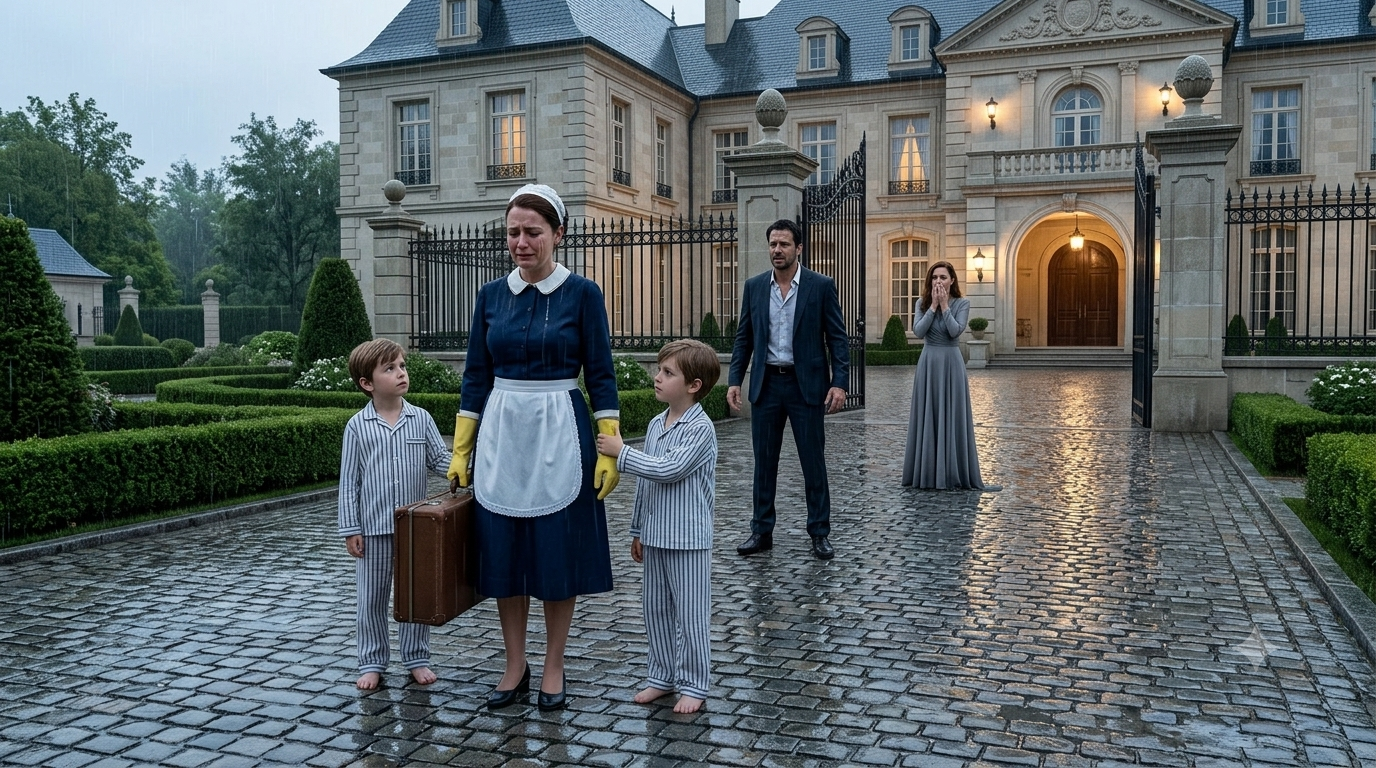
The wheels of Nora Ellis’s suitcase made a thin, broken sound against the stone road outside Vale Crest, the most expensive gated neighborhood on the northern edge of San Francisco. It was not a dramatic sound. It was worse than that. It was ordinary. The sound of cheap plastic wheels catching in cracks, of a zipper that had been repaired twice with safety pins, of a woman leaving a place where she had spent four years giving everything she had without ever truly belonging. Clack. Drag. Clack. Drag. Nora held the suitcase handle with both hands because one hand alone was shaking too badly. Her navy housekeeping dress was still damp at the elbows from polishing the marble staircase. Bright yellow rubber gloves covered her hands. No one had allowed her the dignity of taking them off. She had been pushed out of the Vale estate so quickly that her coat, her spare shoes, and the small framed photograph of her grandmother had been thrown into a cardboard box beside the suitcase.
“Take your things and leave.”
Adrian Vale’s voice still echoed inside her head.
For four years, Nora had worked in the home of one of the most influential men in the technology world. Adrian was the founder of Vale Meridian, a company that built data systems, medical security platforms, and environmental infrastructure used by cities across the country. His face appeared on magazine covers beside phrases like visionary, innovator, and relentless leader. Investors listened when he spoke. Politicians returned his calls. Reporters described his glass-and-steel mansion as a symbol of what a brilliant man could build from nothing.
But Nora had seen the parts no newspaper ever mentioned.
She had seen him standing outside the triplets’ nursery at two in the morning after his wife died, his shoulders rigid, too devastated to walk inside. She had seen him forget to eat for an entire day during merger negotiations. She had seen him glance at the three little boys racing through the hallways and look frightened, not annoyed, as if loving them too much had become more terrifying than losing them.
Finn, Callum, and Owen Vale were six years old. They had been born minutes apart, on the same storm-heavy night their mother, Grace, died from complications after delivery. Adrian had gained three sons and lost the woman he loved before he even had time to understand how to hold any of them. The mansion had always been full of staff, tutors, drivers, security officers, and expensive toys, but for the first year after Grace’s death, it had been painfully short on warmth.
Then Nora arrived.
She had been hired as a housekeeper, nothing more. She cleaned the guest rooms, organized the pantry, and polished the windows that overlooked the bay. But children did not care about job titles. They cared about who sat beside them when nightmares woke them. They cared about who remembered which child hated peas, which one refused to sleep without his green dinosaur, and which one cried silently because he believed crying too loudly would make people leave.
Nora became that person.
She taught Finn how to tie his shoes after he refused help from three different tutors. She sat beside Callum during thunderstorms because he believed lightning could break through the ceiling. She helped Owen learn the alphabet by turning letters into pirate maps. She never tried to replace Grace. She spoke about their mother when they asked. She showed them the photographs Grace had left in a memory box and told them that being loved by someone who was gone did not mean they had to stop loving the people who were still here.
And now Adrian had thrown her out because a watch was missing.
Not just any watch.
It was Grace’s moonstone watch, an antique piece Adrian had kept locked in the study since the day she died. Celeste Ward, Adrian’s fiancée, had found it inside Nora’s tote bag thirty minutes earlier. She had stood in the middle of the living room in a silk blouse and diamond earrings, her hand pressed dramatically to her chest as if grief had just struck her.
“I didn’t want to believe it,” Celeste had said, her voice soft enough to sound wounded. “But I saw Nora coming out of the study. Then I found this in her things.”
Nora had stared at the watch, unable to speak.
She had never touched it.
She had never entered Adrian’s private study without permission.
But Celeste had known exactly where Nora kept her bag.
She had known exactly how to make the evidence look believable.
Adrian had stood near the fireplace, exhausted from a flight and furious from a board dispute. He had not asked Nora one question before judgment entered his face. He had looked at the watch in Celeste’s hand, then at Nora, and something in him had shut down.
“You had every opportunity to tell the truth,” he said.
“I am telling the truth,” Nora replied. “I didn’t take it.”
Celeste lowered her eyes with perfect sadness.
Adrian did not look at Nora again.
“Leave,” he said.
Nora had tried once more.
“Please check the upstairs hallway cameras. Please check the study logs. Please, Adrian, you know me.”
His expression hardened at the sound of his name.
“You are not in a position to tell me what I know.”
The words had cut deeper than he understood.
Because Nora knew something Adrian did not.
Celeste Ward had not only wanted her gone.
Celeste wanted the boys gone too.
Nora had heard enough over the past month to know that something terrible was being planned. Late-night calls behind closed doors. Mentions of private schools overseas. A lawyer discussing “emergency guardianship” and “behavioral placement.” Celeste had smiled sweetly at Adrian in public while privately calling the boys “unfinished business” and “the obstacle between us and a real future.”
Nora had been gathering proof.
She had written dates and times in a little blue notebook hidden beneath the lining of her suitcase. She had taken a photograph of a document Celeste left on the printer. She had planned to speak to Adrian carefully, when he was calm enough to listen.
But now she was outside the gates with a suitcase, yellow gloves, and a heart breaking not because she had lost a job, but because three little boys were still inside with the woman she no longer trusted.
Nora kept walking.
She told herself not to look back.
Then a scream tore through the quiet street.
“MISS NORA!”
Her entire body stopped.
“MISS NORA, WAIT!”
Nora turned around.
The front doors of the Vale estate had burst open.
Three small figures were running toward her barefoot.
Finn. Callum. Owen.
Their pajamas were torn at the knees. Rainwater streaked their hair. Blood marked their hands and forearms from shallow cuts, bright against their pale skin. One of them was crying so hard he could barely breathe. Another clutched a torn piece of blue fabric in his fist.
And behind them, Adrian Vale was running.
Not walking.
Not commanding security from a distance.
Running.
For the first time in Nora’s life, she did not see a billionaire, a founder, or a man whose name could make a room go silent.
She saw a father who had just realized he had made a mistake too large to understand.

Part 2: The Children Who Ran Toward Her
The boys reached Nora before Adrian did.
Finn crashed into her first, wrapping both arms around her waist so hard that the suitcase handle slipped from her hands. Callum buried his face against her uniform, shaking violently. Owen stood just behind them, pale and silent, clutching the ripped blue fabric in one fist and the small silver keycard from the mansion’s inner corridor in the other.
“Don’t let her take us,” Finn sobbed.
Nora dropped to her knees, her yellow gloves suddenly ridiculous against the sight of blood on their arms. “What happened? Where is Celeste?”
“She said Daddy said we had to go away,” Callum cried. “She said we were going to a school where nobody comes back.”
Nora felt the world tilt.
Owen, the quietest of the three, held out the torn blue fabric. It was part of Celeste’s dress. “She locked us in the sky room,” he whispered. “She told us to wait for the van.”
The sky room was the glass conservatory at the far end of the estate, built years ago by Grace because she had loved stars and plants and quiet mornings. Adrian rarely went there now. The boys used it as a playroom, though Nora had noticed Celeste avoiding it whenever Grace’s name came up.
“Did she hurt you?” Nora asked, trying to keep her voice steady.
Finn shook his head quickly. “She got mad when we didn’t want to go. She grabbed Callum’s arm. Then she said we had to stop yelling or Daddy would be disappointed.”
Callum held up his wrist. A red mark circled it.
Nora’s chest tightened.
“Owen broke the glass door,” Finn whispered. “We climbed out.”
The boys had escaped through the conservatory’s side door, which had shattered when Owen used a metal plant stand to break the lock. The cuts on their arms were not deep, but they were enough to make Nora’s hands tremble as she checked them. Their feet were wet and bleeding from running across the gravel drive.
Then Adrian reached them.
He stopped a few feet away, breathing hard, rain darkening the shoulders of his shirt. For a moment, he did not move. His eyes traveled from the boys clinging to Nora, to the blood on their arms, to the broken blue fabric in Owen’s hand.
“Finn,” he said, his voice barely audible. “Callum. Owen.”
None of the boys looked at him.
They held tighter to Nora.
Adrian’s face changed.
Not in anger.
In horror.
“Nora,” he said, but she did not look up. She was pressing a clean handkerchief from her pocket against Callum’s arm while trying to keep Finn from trembling too hard.
“Call Mateo,” she said. “Tell him to lock every gate. No one leaves this property.”
Adrian blinked.
“Why?”
Owen finally lifted his face.
“There’s a van,” he whispered. “The man said he was taking us to the blue school.”
Adrian went still.
Nora looked at him now.
“I tried to tell you,” she said quietly. “I tried to tell you Celeste was planning something.”
The guilt that crossed Adrian’s face was almost unbearable to watch.
But there was no time for it.
At the far end of the circular drive, a dark van rolled toward the gate.
It had no company logo. No school crest. No visible license plate from where Nora stood. The gate sensors had already begun opening because the driver had been given access through the household system.
Mateo Ruiz, Adrian’s head of security, sprinted from the side entrance with two guards behind him.
“Close the gate!” Adrian shouted.
The iron gates began to move.
The van accelerated.
For one terrible second, Nora thought it would make it through.
Then Mateo’s security vehicle cut across the drive and blocked the exit. The van stopped hard. Its driver threw the door open and tried to run, but security officers reached him before he took three steps.
Adrian stared at the scene.
“What is happening?” he asked.
No one answered immediately.
Because the real answer was standing in the doorway of the mansion.
Celeste Ward had come outside.
Her hair was loose now. One side of her blue dress was torn. There was a small cut across her palm, probably from the shattered conservatory door. But her expression was almost calm.
Too calm.
She looked at the boys, then at Nora, then at Adrian.
“They were frightened,” Celeste said. “They misunderstood. I was trying to keep them safe.”
Finn turned around so quickly that Nora felt his body jerk against her.
“She lied,” he shouted. “She said Daddy didn’t want us anymore.”
The street fell silent.
Even the rain seemed to hesitate.
Adrian looked at Celeste.
For years, he had trusted people who looked composed. He had built his career around reading negotiations, spotting weaknesses, and understanding who was bluffing. But in that moment, he saw something he had never allowed himself to see.
Celeste did not look frightened for the boys.
She looked frightened because her plan had failed.
Part 3: The Blue Room
The police arrived within fifteen minutes, though to Nora it felt like an hour. Mateo had already secured the gate, detained the van driver, and sent a team through the estate. Adrian stood in the driveway beside his sons, his hands hanging uselessly at his sides as Nora cleaned their cuts with the emergency kit Mateo brought from the security office. He wanted to help. Nora could see it. But every time he stepped closer, the boys tightened around her.
That was the consequence he had not expected.
He had thrown Nora out.
And in doing so, he had shown his children that the one person who made them feel safe could disappear at any moment.
Callum was the first to speak clearly.
“Celeste told us to go to the sky room,” he said, staring at the bandage around his wrist. “She said there was a surprise.”
“What kind of surprise?” Detective Lena Park asked gently.
“A school,” Finn said. “But not like our school. She said it was far away and nobody could visit until we learned how to behave.”
Owen held the torn blue fabric tighter.
“She said Daddy already signed the papers.”
Adrian’s face went white.
“I never signed anything,” he said.
The detective looked toward him. “Mr. Vale, do you know of any pending school enrollment, travel authorization, or guardianship agreement?”
“No.”
Nora’s eyes closed briefly.
She knew exactly what that meant.
Celeste had been moving faster than anyone realized.
The police entered the conservatory with Mateo and found the proof before the first ambulance left the property. On a low table near the shattered door were three small overnight bags. Inside each one were new clothes, travel documents, copies of the boys’ birth certificates, and passports that Adrian had believed were locked in a safe inside his study. There were also printed forms from a private therapeutic academy in another country, signed with what looked like Adrian’s name.
The signatures were forged.
Beside the paperwork sat a sealed envelope addressed to “Mr. Julian Redd,” the driver of the van. Inside was a cash advance and instructions to transport “three minor children” to a private airfield outside the city.
The message was clear.
Celeste had not been planning a school visit.
She had been planning to remove Adrian’s children from the country.
Nora sat on the edge of the curb with Owen in her lap, pressing a blanket around his shoulders while officers moved through the estate. She felt numb. She had feared Celeste. She had suspected something cruel. But even Nora had not imagined the plan had reached this point.
Adrian walked toward her slowly.
“Why didn’t you tell me sooner?” he asked.
Nora looked up at him.
There was no accusation in his voice now.
Only devastation.
“I tried,” she said. “You were always busy. You were always in meetings. When I asked to speak privately, Celeste said you were under too much pressure. She told me I was overstepping.”
“You should have come to me anyway.”
“I did,” Nora replied. “Three times.”
Adrian went silent.
Nora continued, because once the truth began, she could not keep carrying it alone.
“The first time was after I heard her on the phone talking about a boarding program. The second time was after I found copies of travel documents on the printer. The third time was yesterday, when I saw her meet the driver near the lower gate.” She looked toward the mansion. “You said you were tired. Celeste said I was imagining things. And I started wondering whether maybe I was.”
Adrian closed his eyes.
“I should have listened.”
“Yes,” Nora said.
The single word landed harder than anger.
From inside the estate, Mateo emerged carrying a small evidence bag. Inside was Grace’s moonstone watch.
There was something tucked beneath it.
A folded note.
Mateo handed it to Detective Park.
The note was written in Celeste’s handwriting.
Put this in the housekeeper’s bag before he returns. He will do the rest.
Adrian stared at the words.
For several seconds, he did not move.
Then he looked at Nora’s yellow gloves.
The gloves he had made her wear while leaving.
The gloves he had not given her time to remove.
“I’m sorry,” he said.
Nora’s laugh was quiet and broken.
“Sorry is not enough yet.”
Adrian nodded.
“I know.”
And for the first time since Grace died, the billionaire who had always believed he could solve any crisis with speed, money, and authority understood that some damage could not be repaired by an apology.
It had to be repaired by what he did next.
Part 4: The Woman Behind the Smile
Celeste Ward was arrested that night.
The news did not reach the public immediately. Mateo’s team worked with the police to keep the children’s identities protected, and Adrian’s attorneys filed emergency privacy orders before dawn. But inside the Vale estate, the silence had changed. The house no longer felt polished and controlled. It felt exposed. Every corridor seemed to hold a secret. Every locked drawer seemed suspicious. Every room where Celeste had smiled now carried the memory of what she had intended to do.
Adrian sat in the study until sunrise, staring at Grace’s moonstone watch on the desk.
Nora had not returned to the house.
She had taken the boys to the hospital for their cuts, then agreed to stay in a private family suite until the police could confirm that the van driver had no accomplices nearby. Adrian offered her a room in the estate. She refused.
“I don’t know if I can walk back into that house tonight,” she said.
He did not argue.
That was new for him.
For years, Adrian had mistaken decisiveness for wisdom. If a problem appeared, he solved it. If someone disagreed, he presented logic until they stopped. If his children cried, he called a tutor, a therapist, a doctor, or Nora. He believed providing everything meant he was doing enough.
But he had never truly listened.
Not to Nora.
Not to the boys.
Not even to himself.
His late wife, Grace, had known that about him. Before she died, she had once told him, “You think you protect people by building walls around them. But sometimes people need you to sit down and ask what they are afraid of.”
Adrian had laughed at the time.
He remembered that now with a pain so sharp he could barely breathe.
The next morning, Detective Park came to the hospital with more information. The van driver had confessed quickly. He was not a professional kidnapper. He was a private transport contractor with debts. Celeste had paid him through an intermediary company connected to a man named Grant Hollis, one of Adrian’s senior financial advisers.
Grant had worked with Adrian for nearly a decade.
He had helped manage trust structures after Grace’s death.
He had been the one who suggested creating a complex guardianship plan “to protect the children from public attention.”
He had also been the one who had advised Adrian to postpone certain inheritance discussions until the boys were older.
Now investigators found that Grant and Celeste had been working together for months.
Grace’s will had left a controlling interest in a family foundation to her sons. The foundation did not give them direct power yet, but when the boys reached adulthood, they would control a substantial portion of Vale Meridian voting shares. Until then, Adrian served as trustee. If the children were removed from the country, declared emotionally unstable, or placed under emergency guardianship, Grant could petition to become temporary co-trustee. Celeste would gain influence through marriage to Adrian.
It was not only about getting rid of inconvenient children.
It was about money.
Power.
Control.
Nora listened from the corner of the hospital room while the detective explained.
She felt sick.
Celeste had acted like the boys were obstacles because, to her, they were.
Not children.
Not grieving little people who missed a mother they barely remembered.
Obstacles.
Finn sat on the bed beside Callum, drawing circles on the blanket with his finger.
“Is she coming back?” he asked.
The room went quiet.
Adrian looked at him.
“No,” he said. “She will not come back here.”
“Did she make you send Miss Nora away?” Owen asked.
Adrian’s throat tightened.
“No,” he said slowly. “That was my choice.”
Nora looked at him.
He did not look away.
“I made the wrong choice,” Adrian continued. “I believed something before I asked questions. I hurt Miss Nora. I hurt all of you.”
Finn looked down.
“Are you going to send us away too?”
The question broke the room open.
Adrian moved closer to the bed, then stopped when he saw the boys tense.
He lowered himself to one knee instead.
“No,” he said, his voice unsteady. “Never. Not because you are loud. Not because you are sad. Not because you miss your mother. Not because you make mistakes. You are my sons. You belong with me.”
Callum’s eyes filled with tears.
“But Miss Nora belongs with us too,” he whispered.
Adrian looked toward Nora.
She stood with her arms folded, exhausted, hurt, and still somehow protective of the children.
He knew what he had to say.
“You’re right,” Adrian told his son. “She does.”
Part 5: The Proof He Had Refused to See
Nora’s little blue notebook became the center of the investigation.
She had hidden it inside the lining of her suitcase because she had not trusted anyone in the house enough to leave it in plain sight. The notebook contained dates, names, snippets of conversations, descriptions of cars, and notes about strange deliveries. It was not perfect evidence on its own. Nora knew that. She had written it because she was scared and needed to remember the details.
But when investigators compared her notes with security logs, phone records, gate access reports, and financial transfers, the pattern became undeniable.
Celeste had met Grant Hollis at a private restaurant three times in the past month. She had used Adrian’s old tablet to access the household passport safe. She had instructed a house staff assistant to disable a hallway camera for “renovation testing.” She had transferred money through a shell company to the transport driver. And the missing moonstone watch had been planted in Nora’s bag less than an hour before Adrian returned from his flight.
The final piece came from an audio recording Nora had forgotten she possessed.
Three weeks earlier, she had been checking the laundry room late at night when she heard Celeste arguing with Grant in the adjoining study. Nora had not intended to listen. But when she heard the words “take the boys out of the country,” she had pulled out her phone and recorded thirty-six seconds.
It was not a full conversation.
It did not need to be.
Celeste’s voice could be heard clearly.
“Once Adrian believes Nora betrayed him, the children will have no one left who knows how to fight for them.”
Grant’s voice followed.
“He will sign anything if you make it look like a safety issue.”
Celeste laughed softly.
“He has spent six years avoiding being their father. He won’t suddenly become one now.”
When Detective Park played the recording, Adrian sat perfectly still.
Nora watched him hear the truth about himself.
Not only that Celeste had planned to betray him.
But that she had understood him well enough to use his weakness as a weapon.
He had avoided the hard parts of fatherhood because he feared failing.
And by avoiding them, he had made it easier for someone else to hurt his sons.
After the recording ended, Adrian left the hospital room without a word.
Nora found him ten minutes later in the quiet corridor outside the pediatric wing. He stood beside a window overlooking the parking lot, his hands braced against the glass.
“I don’t deserve to ask you for anything,” he said without turning around.
Nora stayed a few steps behind him.
“No,” she replied.
He nodded as if he expected that.
“I was so angry when I saw the watch,” he continued. “Not because I believed you were a thief. I think part of me knew you weren’t. But I had spent years holding onto that watch because it was one of the last things Grace touched. And when I saw it in your bag, I wanted someone to blame.”
Nora’s expression softened slightly, though her hurt remained.
“I understand grief,” she said. “But grief is not permission to destroy the people who stayed.”
Adrian closed his eyes.
“I know.”
“You don’t get to fix this by offering me money.”
“I know.”
“You don’t get to make me return because the children are asking for me.”
“I know.”
Nora watched his shoulders lower.
“What do you want from me?” he asked.
For the first time, his voice did not sound like a man bargaining.
It sounded like a man listening.
Nora looked through the glass at the city below.
“I want you to become the father they deserve,” she said. “Not just when there is danger. Not just when you are scared. Every day. At breakfast. At bedtime. During the boring parts. During the ugly parts. When they ask questions you don’t want to answer. When they remind you of Grace. When they disappoint you. When they need you more than your work does.”
Adrian turned toward her.
Nora held his gaze.
“And I want you to understand that I loved them because someone had to. But I should never have been the only person standing between them and harm.”
The words stayed with him.
They would stay with him for the rest of his life.
Part 6: The Father Who Had to Learn Slowly
Adrian did not ask Nora to come back to work the next day.
He did not offer her a raise, a new title, a larger apartment, or a contract designed by lawyers.
Instead, he asked her what the boys needed.
“Consistency,” Nora said.
“What does that mean?”
“It means they need to know who will be there when they wake up. They need to know their father does not disappear into meetings for three days and then return with gifts instead of answers. They need to know that when they are afraid, someone will sit with them until the fear passes.”
Adrian nodded slowly.
“So I should stay home?”
“Sometimes,” Nora said. “But this is not about quitting your life. It is about making them part of it.”
That was harder than any negotiation Adrian had ever faced.
For the first few weeks after the investigation began, he moved his work schedule around the boys’ routines. He attended breakfast every morning. He walked them to the car for school. He joined their sessions with a child therapist, not because the therapist ordered him to but because he finally understood that the boys needed to see him show up in places that were uncomfortable.
At first, it did not go well.
Finn refused to speak to him for days.
Callum asked the same question every night: “Are you mad at Miss Nora?”
Owen began hiding small objects inside his pillowcase—keys, toy cars, socks, crayons—because he seemed convinced someone would suddenly tell him to pack again.
Adrian did not know how to answer any of it.
His instinct was to solve. Buy new toys. Change rooms. Add more security. But Nora kept reminding him that safety was not made of expensive things.
“It is made of people doing what they say they will do,” she told him.
So Adrian did that.
When he promised to read a story, he read the story.
When he promised to be home before dinner, he came home before dinner.
When Finn asked why he had believed Celeste, Adrian did not make excuses.
“I was wrong,” he said. “And I hurt someone you love because I was wrong.”
Finn looked at him for a long time.
“Will you believe me next time?”
Adrian’s voice broke.
“Yes,” he said. “I will listen first.”
Nora did not return as a housekeeper.
She returned only after Adrian agreed to a different arrangement. She would serve as the boys’ family support advocate while the legal case continued, working with their therapist, school, and household staff. She would have authority to report concerns directly to an independent child welfare consultant. She would not be under Celeste’s old chain of command. She would not be expected to clean the mansion, manage staff, or pretend that a title could erase what had happened.
Adrian signed the agreement without changing a word.
When Nora walked back through the estate’s front doors for the first time, the boys ran toward her so hard that Mateo had to step aside to avoid being knocked over.
“Miss Nora is back!” Callum shouted.
Finn threw both arms around her.
Owen did not say anything. He simply held out the blue fabric from Celeste’s torn dress. He had kept it folded in his pocket since the night they escaped.
Nora knelt beside him.
“You don’t need to keep this anymore,” she said gently.
Owen looked uncertain.
“It reminds you that you were scared,” she continued. “But you don’t have to carry the scary part forever.”
He looked at Adrian.
Adrian crouched beside them.
“Can we put it in a box?” Owen asked.
“Yes,” Adrian said. “And we can tell the truth about it when you are ready.”
Together, they placed the torn fabric into a memory box—not to hide it, but to make it part of a story that would no longer control them.
Part 7: The Hearing That Changed the House
Celeste’s legal case moved slowly, as serious cases often did. Her lawyers claimed she had only arranged a school transfer and that the boys had panicked because they misunderstood her. Grant Hollis denied planning to seize control of the family foundation. He claimed the forged documents were “contingency drafts” prepared without malicious intent.
But evidence had a way of becoming louder when enough pieces were placed together.
The transport driver testified.
The forged signatures were confirmed.
The financial transfers were traced.
The house assistant admitted that Celeste had ordered the camera disabled.
And Nora’s recording became impossible to explain away.
During the preliminary hearing, Celeste finally looked at Adrian across the courtroom.
She no longer looked polished.
No silk dress. No careful makeup. No rehearsed smile.
For a moment, she looked tired. Small. Almost human.
“Do you know why I did it?” she asked him quietly while lawyers moved around them.
Adrian did not answer.
“You loved them because they were Grace’s,” Celeste said. “You loved her even after she died. There was never room for anyone else.”
Adrian’s expression did not soften.
“You could have left,” he said.
Celeste laughed bitterly.
“And walk away from everything?”
“There it is,” Adrian replied. “Everything.”
He looked toward the courtroom doors where Nora waited with the boys’ advocate.
“You saw three children and thought they were standing between you and a life you wanted. You never understood that they were the life.”
Celeste looked away.
Adrian did not feel triumph.
He felt sorrow.
Not for what she had done.
But for how easily he had allowed someone who saw love as an inconvenience into his children’s home.
The judge issued protective orders preventing Celeste and Grant from contacting the boys. Criminal charges moved forward. The court also required a review of the family trust structure, and Adrian willingly agreed to independent oversight. He understood now that power without accountability had made it too easy for people around him to act in secret.
When reporters later asked him for a statement outside the courthouse, Adrian stopped at the steps.
They expected anger.
They expected a billionaire defending his empire.
Instead, he said, “My children were almost treated like assets in a dispute over wealth and control. They are not assets. They are children. I failed to see the danger because I thought providing for them was the same as protecting them. It was not. I am learning the difference.”
The statement spread across the city.
Some people praised him.
Others criticized him for not seeing the truth sooner.
Adrian accepted both.
Because Nora had taught him that accountability was not about controlling the story.
It was about telling the truth even when it did not make you look good.
Part 8: The Things Money Could Not Repair
A month later, Adrian found Nora in the conservatory.
The shattered glass door had been replaced, but Nora had asked the workers to leave one small crack in the old stone threshold untouched. It was harmless now, barely visible beneath the new frame. She said the boys needed to remember that the room had been repaired without pretending it had never broken.
The boys were outside in the garden with Mateo, chasing each other between the lavender bushes. Their laughter drifted through the open windows.
Adrian stood in the doorway for several seconds before Nora noticed him.
“I thought you had a meeting,” she said.
“I did.”
“And?”
“I left.”
Nora raised an eyebrow.
“On time,” he added.
That made her smile, though only slightly.
Adrian walked closer.
“I have been thinking about what you said,” he told her. “About not fixing things with money.”
Nora folded a blanket on the bench beside her.
“And?”
“I still don’t know how to do this.”
“Good.”
He looked surprised.
“Why is that good?”
“Because when you think you know everything, you stop listening.”
Adrian let out a small breath.
“I want to make something right,” he said. “Not for you to forgive me. Not because I want people to think I am generous. I want to make sure no one else ends up in the position you were in.”
Nora looked at him carefully.
“What are you thinking?”
“The Grace Vale Family Center,” he said. “A place for children who lose parents, for caregivers raising children without enough support, for families facing custody crises, for household workers who see danger but do not know who will believe them.”
Nora’s hands stopped moving.
Adrian continued.
“It would have legal aid. Counseling. Emergency childcare. Advocacy staff. Training for domestic workers and nannies to report signs of child endangerment without losing their jobs.”
Nora’s eyes filled before she could stop them.
“You thought about that?”
“For weeks.”
She looked toward the garden where Finn had fallen into the grass laughing while his brothers piled on top of him.
“It would need to be independent,” she said. “Not something your company controls.”
“I agree.”
“It would need people with actual experience making decisions.”
“I agree.”
“And it should not be called the Adrian Vale Center.”
He smiled faintly.
“I agree with that too.”
Nora looked at him.
“Why?”
“Because this is not about me.”
For a long moment, the conservatory was quiet.
Then Nora nodded.
“Then I will help design it.”
Adrian did not reach for her hand.
He did not assume he had earned that.
He only said, “Thank you.”
And for Nora, that mattered.
Because gratitude, when it was real, did not sound like ownership.
It sounded like respect.
Part 9: The Boy Who Stopped Packing
Healing did not happen in one dramatic moment.
It happened in small ones.
Finn began drawing pictures of the family again. At first, he always drew Nora between himself and Adrian. Months later, he drew Adrian holding one of his hands and Nora holding the other.
Callum stopped asking whether he would be sent away every night. He began asking ordinary questions instead. Could he have a dog? Could he eat pancakes for dinner? Did astronauts have to brush their teeth in space?
Owen took the longest.
For weeks, he still hid objects in his pillowcase. He still checked the windows before bed. He still kept his shoes near the door.
Then one evening, Adrian found him sitting on the floor beside the bed, holding a small backpack.
“What’s in there?” Adrian asked gently.
Owen looked down.
“Important things.”
“Like what?”
“My dinosaur. My socks. The picture of Mommy. My crayons.”
Adrian sat on the floor beside him.
“Do you think you need to leave?”
Owen did not answer.
Adrian did not rush him.
Finally, Owen whispered, “Sometimes.”
Adrian’s heart broke quietly.
He looked at the backpack.
Then he said, “Would it help if we made a new rule?”
Owen looked up.
“Anytime you feel scared that you have to leave, you tell me. Or Nora. Or Mateo. And we will talk about it before you pack.”
“What if you’re busy?”
“I will stop being busy.”
Owen studied him, testing the truth of it.
Then he unzipped the backpack and took out one item at a time.
The dinosaur.
The socks.
The photograph of Grace.
The crayons.
Adrian did not touch any of them.
He simply stayed on the floor until Owen climbed into bed.
That night, for the first time since Celeste’s plan was exposed, Owen left his shoes in the closet.
Nora noticed the next morning.
She said nothing at first.
Then she looked at Adrian across the breakfast table.
“He is starting to believe you,” she said.
Adrian swallowed.
“I know.”
It was not a victory.
It was a responsibility.
Part 10: The Day the House Became a Home
One year after Nora had been thrown out of the Vale estate, the Grace Vale Family Center opened its doors.
The building was not grand in the way Adrian’s offices were grand. It had warm brick walls, wide windows, a small garden, and a playroom filled with books, blankets, and bins of crayons. The legal aid offices were down one hallway. Therapy rooms were down another. There was a kitchen where parents could make tea while waiting for appointments. There were social workers, counselors, attorneys, and volunteers. There was even a quiet room designed for children who needed to sit somewhere safe without being asked too many questions.
Nora stood near the entrance on opening day, wearing a simple dark green dress instead of a housekeeping uniform. A small brass plaque near the door listed her title:
Nora Ellis, Director of Family Advocacy.
She stared at it for a long time.
Adrian stood nearby with the boys.
“You earned it,” he said.
Nora glanced at him.
“It still feels strange.”
“That is because for too long, people treated the work you did as invisible.”
The boys rushed toward her.
Finn carried a giant box of crayons.
Callum held a stuffed dog someone had donated.
Owen held a framed photograph of Grace.
“Where should we put Mom?” he asked.
Nora looked at Adrian.
He nodded toward the center’s family room.
“Somewhere people can see her,” he said.
Together, they placed Grace’s photograph on a shelf beside a small vase of wildflowers.
No one called it a memorial.
It was not about grief alone.
It was about the fact that Grace’s love had not disappeared when she died. It had lived inside her children. It had lived in the home she designed. It had lived in the woman she trusted to care for them when no one else knew how. And now it lived in a place built to help other families survive the moments when love alone was not enough.
During the opening remarks, Adrian stood at the podium but did not speak for long.
“I used to believe that protection meant having enough money to solve every problem,” he said. “I was wrong. Protection begins with paying attention. It means listening when someone says something is wrong. It means believing the people who have earned your trust. It means understanding that children do not need perfect parents. They need present ones.”
Then he stepped aside.
Nora spoke next.
She looked at the families gathered in front of her: grandparents raising grandchildren, single parents holding toddlers, caregivers who looked tired enough to fall asleep standing up, domestic workers who had come because they wanted to learn how to report danger safely.
“I once thought being invisible was the safest thing a person could be,” Nora said. “I thought if I worked hard, stayed quiet, and did not ask for too much, I could protect the people I loved. But silence can become dangerous when it allows the wrong people to make decisions in the dark.”
Her voice softened.
“This center exists because someone finally listened. It exists because three little boys were brave enough to run toward the person they trusted. And it exists because love is not just a feeling. Love is action. Love is asking questions. Love is believing someone before it is too late.”
The room applauded.
Owen looked at Adrian.
“Did Miss Nora save us?” he whispered.
Adrian looked at Nora, then at his sons.
“Yes,” he said. “She did.”
Finn frowned.
“But you saved us too.”
Adrian’s eyes filled.
“I am trying,” he said quietly.
Callum thought about that for a moment.
Then he nodded.
“That’s good.”
Part 11: The Purple Gloves
That evening, after the opening celebration ended, Nora returned to the Vale estate with the boys.
The house felt different now.
Not because the furniture had changed.
Not because the security gates were stronger.
Not because Celeste’s photographs had been removed.
It felt different because people spoke more honestly inside it.
Adrian came home for dinner.
Not because there was a crisis.
Not because cameras were present.
Just because it was dinner.
The boys argued about whether pirates could use smartphones. Nora made pasta. Mateo arrived late and pretended not to enjoy the dessert. Adrian burned garlic bread and tried to claim it was intentional.
After the meal, Finn found something in the kitchen drawer.
Nora’s yellow cleaning gloves.
The pair she had been wearing when Adrian threw her out.
Finn held them up.
“Why are these here?”
Nora looked at them for a moment.
“I forgot them that day,” she said.
Adrian became quiet.
Finn looked between them.
“Are they sad gloves?”
Nora smiled faintly.
“They used to be.”
Then Adrian stood, took the gloves gently from Finn, and placed them on the kitchen counter.
“They are not sad gloves anymore,” he said. “They remind us to do better.”
Owen climbed onto a chair.
“Can we paint them?”
Nora laughed.
“Paint cleaning gloves?”
“Yes,” Owen said. “Then they can be happy gloves.”
So that was what they did.
The boys covered the yellow rubber with streaks of blue, red, green, and purple. Callum painted a crooked star. Finn painted three small stick figures. Owen painted a tiny house with a garden.
Adrian painted nothing.
He only watched.
At one point, Nora glanced at him.
“You can paint something,” she said.
He looked uncertain.
“I don’t know what to paint.”
Nora handed him a brush.
“Then paint what you are learning.”
Adrian stared at the gloves for a long time.
Then he painted a small open door.
Final Lesson
The most important kind of wealth is not money, influence, or power. It is the ability to recognize when someone is carrying pain alone and choose to stand beside them before it is too late. Adrian learned that providing a beautiful house, expensive schools, and endless resources could never replace presence, trust, and attention. Nora learned that speaking up, even when nobody wants to listen, can protect the people who cannot yet protect themselves. And the three boys learned that being loved does not mean nobody will ever make mistakes; it means the people who love you will take responsibility, tell the truth, and work every day to become safer than they were before. Real family is not built by blood, money, or appearances. It is built by the people who stay, listen, and choose one another when it matters most.