My mother left me a house I never knew existed.
She had always told me we had no family property.
No old home.
No inheritance.
No relatives waiting somewhere in the distance.
Just the two of us.
But three days after her funeral, a lawyer handed me a key.
The house was two hours away.
It had been locked for almost thirty years.
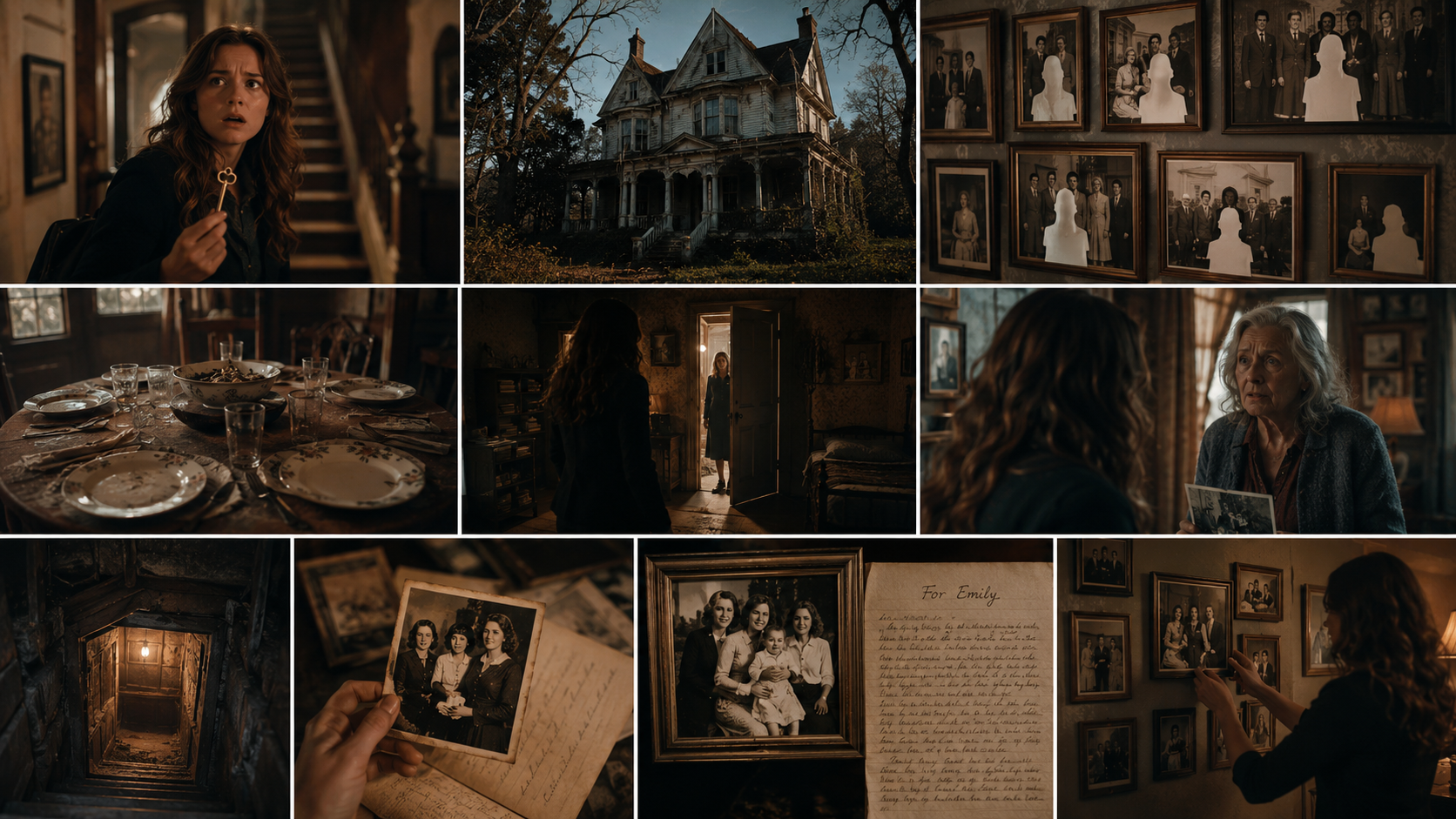
When I arrived, everything inside looked untouched.
The dishes were still on the table.
Family photographs covered the walls.
But someone had carefully cut my mother out of every single one.
Then I heard footsteps upstairs.
I thought the house was empty.
A bedroom door slowly opened.
And someone said my name.
“Emily?”
I stopped breathing.
The voice came from the darkness beyond the door.
It was a woman’s voice.
Old.
Weak.
But certain.
She knew me.
I stood at the bottom of the staircase, gripping the dusty wooden banister with one hand and my mother’s key with the other.
“Who’s there?” I called.
No answer.
The old house seemed to hold its breath.
Then the floorboards creaked again.
Slowly.
One step.
Then another.
A figure appeared at the top of the stairs.
For one impossible second, I thought my mother had come back from the dead.
The woman had the same gray eyes.
The same high cheekbones.
The same way of tilting her head slightly when she looked at someone.
But she was older than my mother had been.
Much older.
Her white hair hung loosely around her shoulders, and she wore a faded blue sweater over a long nightgown.
She stared at me.
Then tears filled her eyes.
“Oh, Anna,” she whispered.
My mother’s name.
I couldn’t move.
The woman covered her mouth with one trembling hand.
“No,” she said. “Not Anna.”
She looked at me again.
“Emily.”
I took a step backward.
“How do you know my name?”
The woman slowly descended the stairs.
I wanted to run.
Every instinct told me to get out of that house, get into my car, and call the police.
But there was something in her face.
Something familiar.
“Who are you?” I asked.
She reached the bottom of the stairs and stopped several feet away from me.
“My name is Margaret.”
The name meant nothing to me.
She seemed to understand.
“Your mother never told you about me.”
It wasn’t a question.
I shook my head.
Margaret looked toward the photographs covering the hallway wall.
The photographs that had already made my stomach twist.
Every picture showed families at birthdays, Christmas dinners, summer picnics, and weddings.
And in almost every photograph, there was an empty space.
A carefully cut silhouette.
Someone had taken scissors and removed the same person over and over.
My mother.
“Did you do that?” I asked.
Margaret followed my gaze.
Her face hardened.
“No.”
“Then who did?”
She looked toward the ceiling.
For the first time, I noticed that the house wasn’t as abandoned as the lawyer had claimed.
A lamp upstairs was plugged in.
A small electric heater hummed near the kitchen doorway.
There was a half-empty bottle of water on the table.
Someone had been living here.
“Margaret,” I said, “why are you in my mother’s house?”
She gave me a strange, sad smile.
“Because it was my house too.”
The words landed heavily between us.
I stared at her.
“What do you mean?”
Margaret reached into the pocket of her sweater and removed an old photograph.
Unlike the others, this one had not been cut.
Three young women stood in front of the house.
One was Margaret.
I recognized her immediately, even though she was probably only twenty in the photograph.
The second woman was my mother.
Young.
Smiling.
Happy in a way I had rarely seen.
And between them stood another woman.
She looked almost exactly like both of them.
Three sisters.
I looked up.
“My mother had sisters?”
Margaret nodded.
“Two.”
My knees suddenly felt weak.
“My mother told me she was an only child.”
“I know.”
“Why?”
Margaret looked at the third woman in the photograph.
“Because of what happened to Rose.”
I had buried my mother three days earlier.
Anna Carter had died at sixty-two after a short illness she had hidden from me until hiding it was no longer possible.
That was typical of her.
My mother could hide anything.
Pain.
Fear.
Money problems.
Memories.
Apparently, entire families.
Growing up, I had asked about grandparents.
She said they were dead.
I asked about aunts and uncles.
She said there were none.
I asked why we never visited the town where she grew up.
She would change the subject.
Once, when I was thirteen, I found an old photograph in the back of her closet.
It showed my mother as a teenager standing beside another girl.
They looked so much alike that I asked if the girl was her sister.
My mother snatched the photograph from my hand.
“She was a friend.”
Then she burned it in the kitchen sink.
I had never forgotten that.
But after years of asking questions and receiving silence, I stopped.
Now I was standing inside the answer.
“Sit down,” Margaret said.
We went into the kitchen.
The dishes on the dining table looked as if someone had walked away in the middle of dinner.
Four plates.
Four glasses.
A serving bowl.
Everything covered in decades of dust.
Except for one chair.
That chair was clean.
Margaret sat there.
I remained standing.
“You’ve been living here?”
“Not permanently.”
“How did you get in?”
“I have a key.”
“The lawyer told me the house had been locked for almost thirty years.”
“It was.”
“Then why are you here?”
Margaret looked at me.
“Because I knew Anna had died.”
A cold feeling spread through me.
“How?”
She didn’t answer immediately.
“Margaret.”
“I’ve been watching from a distance.”
“For how long?”
“Most of your life.”
I pushed my chair back.
“What?”
“I never approached you.”
“That doesn’t make it better.”
“I know.”
“Did my mother know?”
“Yes.”
That stopped me.
Margaret reached across the table, but I pulled my hand away.
“Your mother and I had an agreement,” she said. “I would stay away from you. She would make sure the house remained untouched.”
“Why?”
“Because this house contains the truth.”
“About Rose?”
Margaret nodded.
I looked again at the old photograph.
“Who was she?”
“Our youngest sister.”
“What happened to her?”
Margaret’s eyes moved toward the untouched dinner table.
“She disappeared.”
“When?”
“October 18, 1996.”
Almost thirty years earlier.
I looked at the plates.
“Was this the last meal?”
“Yes.”
A chill ran through me.
“Who was sitting here?”
Margaret pointed.
“My father sat there. My mother sat beside him. Rose sat across from me.”
“And my mother?”
Margaret looked at the empty fourth place.
“Anna had already left.”
“Left where?”
“No one knew.”
I frowned.
“You’re saying my mother disappeared too?”
“For six months.”
The room suddenly felt smaller.
Margaret continued.
“Anna and our father fought constantly. He was a controlling man. Violent sometimes. He decided who we could see, where we could go, what we could study. Anna was the only one who fought back.”
That sounded like my mother.
“She wanted to leave,” Margaret said. “Our father told her that if she walked out, she would never be allowed back.”
“So she left.”
“Yes.”
“And then Rose disappeared?”
“Three weeks later.”
“What did the police think happened?”
“They thought Rose ran away to join Anna.”
“Did she?”
Margaret looked directly at me.
“No.”
“How do you know?”
“Because Anna didn’t know Rose was missing.”
According to Margaret, my mother had gone to another state.
She changed her name.
Found work.
Cut contact with everyone.
Six months later, she called home.
Their father answered.
He told her Rose had disappeared because of her.
He said Rose had followed her.
My mother panicked.
She returned.
But by then, there was no trace of Rose.
No body.
No confirmed sightings.
Nothing.
“And the photographs?” I asked.
Margaret’s expression changed.
“Our father cut Anna out.”
“Why?”
“To punish her.”
Even after my mother returned to search for Rose, their father blamed her.
He told the entire town that Anna had encouraged Rose to run away.
Rumors spread.
Some people believed my mother knew where Rose was.
Others believed the sisters had planned the disappearance together.
“My father became obsessed,” Margaret said. “Every day, he removed Anna from another photograph.”
I looked around the room.
There were dozens.
Maybe hundreds.
“He wanted to erase her.”
“Yes.”
“What happened to your parents?”
“Our mother died in 1998. Our father died seven years later.”
“And you?”
“I stayed.”
“In this house?”
“For a while.”
“Why did everyone leave it exactly like this?”
Margaret looked at the table.
“Because the night Rose disappeared never really ended.”
I didn’t understand.
Then Margaret stood.
“There is something you need to see.”
She led me upstairs.
Every step creaked.
At the end of the hallway was the bedroom door that had opened earlier.
Inside was a small room.
Floral wallpaper.
A narrow bed.
Books on shelves.
A cassette player.
Everything frozen in 1996.
Rose’s bedroom.
On the wall were photographs.
Unlike downstairs, these hadn’t been damaged.
My mother was everywhere.
Anna and Rose at the beach.
Anna teaching Rose to ride a bicycle.
The three sisters laughing beneath a Christmas tree.
I walked closer.
Then I saw something that made my heart stop.
A photograph of my mother holding a baby.
On the back, written in faded blue ink, were three words.
Emily — 6 weeks.
I turned toward Margaret.
“You met me?”
“No.”
“Then how did Rose have this photograph?”
Margaret didn’t answer.
“Rose disappeared before I was born.”
Silence.
I looked at the date written beneath the photograph.
October 1996.
I was born in September 1996.
My mind refused to make sense of it.
“My mother told me I was born in Chicago.”
“You were.”
“Then how did this photograph get here?”
“Anna sent it.”
“To Rose?”
“Yes.”
I sat on the edge of the bed.
“So my mother was still talking to Rose after she supposedly cut off the family.”
Margaret nodded.
“They were secretly writing to each other.”
“Why didn’t you tell the police?”
“I didn’t know until years later.”
She pulled a wooden box from beneath the bed.
Inside were letters.
Dozens of them.
All from my mother.
I recognized her handwriting immediately.
The earliest letters described her escape.
Her new job.
Her pregnancy.
My birth.
But the later letters became increasingly frightened.
Rose, don’t tell Father where I am.
He cannot know about Emily.
I received another call last night.
Someone knows where we live.
Then one letter made my hands shake.
Rose, if anything happens to me, take Emily. Do not let Father find her.
I looked at Margaret.
“Why was my mother afraid of her own father?”
Margaret sat beside me.
“Because he had already tried to take you.”
The story changed again.
My grandfather had discovered that my mother had given birth.
He believed she was incapable of raising a child.
He threatened to report her.
Threatened to take custody.
Threatened to find me.
Rose secretly warned my mother.
Then, one week later, Rose disappeared.
“You think your father did something to her?”
“For years, I did.”
“And now?”
Margaret looked toward the bedroom window.
“Now I know he didn’t.”
I felt the room go cold.
“How?”
“Because two months ago, I found Rose.”
I stared at her.
“What?”
“Not alive.”
The words came softly.
“I found where she had been hidden.”
I stood.
“Where?”
Margaret looked down.
“Under this house.”
The basement door was behind the kitchen.
It had been painted shut.
Margaret showed me where she had recently broken the seal.
We descended with flashlights.
The basement smelled of damp stone and old wood.
At the far wall, several shelves had been moved aside.
Behind them was a narrow opening.
Margaret stopped.
“I found it while searching for a water leak.”
Inside the opening was a small hidden room.
The police had already removed the remains, she explained.
The investigation had been quietly reopened.
DNA testing confirmed the remains belonged to Rose.
I felt sick.
“Why didn’t anyone tell my mother?”
“The identification came back the day she died.”
I closed my eyes.
My mother had spent almost thirty years wondering what happened to her sister.
And the answer arrived hours too late.
“Who killed her?”
“We don’t know.”
“But you said you know your father didn’t.”
Margaret raised her flashlight.
On the wall were words scratched into the wood.
ANNA DIDN’T LEAVE ME.
Below them:
M KNOWS.
“M?” I whispered.
Margaret looked at me.
“For years, I thought it meant Mother.”
“Did it?”
“I don’t know.”
Then I noticed something else.
A small metal object on the floor.
A necklace.
My mother’s necklace.
I had seen her wear it every day of my childhood.
Or one exactly like it.
I picked it up.
“No,” I whispered.
Margaret’s face changed.
“What?”
“My mother had this.”
“She couldn’t have.”
“She did.”
I remembered playing with the small silver pendant as a child.
I remembered sitting on my mother’s lap and tracing its shape with my finger.
Then I remembered something else.
She stopped wearing it when I was about ten.
“Maybe there were two,” Margaret said.
I opened the pendant.
Inside was a tiny photograph.
Not of my mother.
Not of Rose.
Of Margaret.
I looked up.
Margaret had gone pale.
“That belonged to Rose.”
A sound came from upstairs.
Both of us froze.
A door closed.
Someone else was in the house.
Margaret turned off her flashlight.
I heard movement above us.
Slow footsteps crossing the kitchen.
Then silence.
“Did you lock the front door?” Margaret whispered.
“Yes.”
She grabbed my arm.
We climbed the basement stairs.
The kitchen was empty.
But something had changed.
The old telephone on the wall was swinging from its cord.
Beside it, on the dusty table, someone had written a message with one finger.
YOU SHOULD HAVE LEFT IT BURIED.
I called the police.
By the time they arrived, whoever had entered was gone.
There were no obvious signs of forced entry.
But one officer found a back window unlocked.
The police questioned Margaret.
They questioned me.
Then Detective Samuel Reed arrived.
He had been working on Rose’s reopened case.
He asked to speak with me privately.
“Your aunt hasn’t told you everything,” he said.
“Which aunt?”
“Margaret.”
I almost laughed.
Three days earlier, I didn’t know I had any aunts.
Now one was dead and another was apparently lying to me.
“What hasn’t she told me?”
Detective Reed opened a folder.
Inside was an old police report.
“Margaret was the last confirmed person to see Rose alive.”
I looked through the report.
Margaret had claimed she went to bed at 10:30 p.m.
Rose was still downstairs.
Their parents were asleep.
The next morning, Rose was gone.
But a neighbor had reported seeing two women arguing outside the house around midnight.
One was Rose.
The other appeared to be Margaret.
“Why wasn’t she arrested?”
“No evidence.”
“And now?”
“Now we have something.”
He showed me a photograph of an object recovered with Rose’s remains.
A bracelet.
Engraved with one name.
Margaret.
My stomach dropped.
I looked through the kitchen doorway.
Margaret was sitting in the living room.
Watching us.
“She said she lost that bracelet years ago,” Reed said.
“Do you believe her?”
“I believe people lie for reasons.”
That night, I stayed in a hotel.
I couldn’t sleep.
At 2:13 a.m., my phone rang.
Unknown number.
I answered.
No one spoke.
Then I heard breathing.
“Who is this?”
A woman’s voice whispered:
“Don’t trust Margaret.”
The call ended.
The next morning, Margaret was gone.
So was the box of letters.
I returned to the house with Detective Reed.
Margaret’s car was missing.
Her clothes were gone.
But she had left something behind.
The old photograph of the three sisters.
On the back, she had written:
Emily, your mother knew the truth. Find the letter she never sent.
“What letter?” I asked.
Reed didn’t know.
We searched the house for hours.
Nothing.
Then I remembered something my mother had done before she died.
Two days before entering the hospital, she gave me an old cookbook.
“Keep this,” she said.
I had laughed.
“Mom, I don’t cook.”
“Keep it anyway.”
At the time, I thought it was another strange request from a dying woman.
Now I drove home and found the cookbook.
Inside the back cover was an envelope.
My name was written across it.
For Emily — only if the house finds you.
My hands trembled as I opened it.
The letter began:
My dearest Emily,
If you are reading this, then I failed to keep the past buried.
My mother told me everything.
Or almost everything.
She had returned to the house the night Rose disappeared.
No one knew.
Rose had called her in panic.
She said their father had discovered the letters and was threatening to find me.
My mother drove through the night.
When she arrived, Rose was waiting outside.
They planned to leave together.
But before they could, Margaret came outside.
There was an argument.
Not because Margaret wanted to hurt Rose.
Because Margaret wanted to go with them.
My mother refused.
She had a baby.
No money.
No safe place.
She could only take Rose.
Margaret became furious.
Years of jealousy exploded.
She grabbed Rose.
Rose pushed her away.
Margaret fell.
Then their mother came outside.
My grandmother.
She had heard everything.
She told Rose she would never allow the family to be destroyed.
The argument moved into the basement.
And there, according to my mother’s letter, Rose fell down the stone steps.
She struck her head.
My mother believed she was dead.
But she wasn’t.
This was the part that haunted my mother for the rest of her life.
Rose had still been breathing.
Their mother knew it.
But instead of calling an ambulance, she panicked.
She believed the scandal would destroy the family.
She ordered my mother and Margaret upstairs.
Then she locked Rose in the hidden room.
Alive.
My mother tried to return.
Their father stopped her.
He had no idea what had happened.
Their mother told him Rose had run away.
By the time my mother escaped the house and returned with help the following day, the hidden room had been sealed.
Their mother swore Rose had left.
My mother doubted her own memory.
She was young.
Terrified.
Exhausted.
And afraid her father would take me.
So she ran.
For decades, my mother lived with one question.
Had Rose been alive when she left?
The answer was on the basement wall.
ANNA DIDN’T LEAVE ME.
Rose had survived long enough to write it.
And the second message—
M KNOWS.
It didn’t mean Margaret.
It meant Mother.
Their mother knew.
I sat on my apartment floor and cried until I couldn’t breathe.
But the letter wasn’t finished.
The final paragraph changed everything again.
Emily, there is one more thing you deserve to know.
I loved you every day of my life. I raised you. I protected you. I chose you in every way that matters.
But I did not give birth to you.
I stopped reading.
The words blurred.
I read them again.
I did not give birth to you.
My mother continued.
Rose did.
I couldn’t move.
According to the letter, Rose had secretly given birth six weeks before she disappeared.
The father was a married man from town.
To protect Rose from their violent father and the scandal he would create, my mother took the baby and left.
Me.
The photograph I had found wasn’t my mother holding her newborn daughter.
It was my aunt holding her sister’s baby.
I was Rose’s daughter.
Anna was my biological aunt.
Margaret was my aunt too.
And the woman whose remains had been found beneath the house was my real mother.
Everything I knew about myself shifted.
But there was one final line.
Margaret knows. She has always known. And if she ever tells you I stole you from Rose, do not believe her. Rose asked me to save you.
My phone rang.
Margaret.
I answered.
“Where are you?”
Her voice was shaking.
“Emily, listen to me.”
“I know.”
Silence.
“I read the letter.”
She began crying.
“Then you know what happened.”
“I know Rose was my mother.”
“Yes.”
“Why did you disappear?”
“Because someone is trying to make it look like I killed her.”
“Your bracelet was found with her.”
“I gave that bracelet to Rose.”
“Why?”
“Because she was leaving.”
I closed my eyes.
“Where are you?”
“At the cemetery.”
I found Margaret sitting beside my mother’s grave.
Detective Reed came with me.
Margaret didn’t run.
She handed him the missing box of letters.
“I took them because one was missing,” she said.
“Which one?”
“The last letter Rose wrote to Anna.”
She had found it years earlier.
She gave it to me.
The paper was fragile.
The handwriting uneven.
Anna,
I know you are afraid. I am too. But Emily is safer with you. If anything happens to me, don’t bring her back here. Promise me she will grow up somewhere she isn’t afraid.
Tell her about me when the time is right.
Tell her I loved her before she had a name.
I couldn’t finish reading aloud.
Margaret put her hand over mine.
For the first time, I let her.
The investigation eventually confirmed much of what my mother’s letter described.
Rose’s injuries were consistent with a fall.
Evidence suggested she had survived for some time inside the hidden room.
My grandmother had died years ago.
There would be no trial.
No dramatic courtroom confession.
Some crimes outlive the people who committed them.
But the truth remained.
Margaret was cleared.
The bracelet had been a gift.
The anonymous phone call had come from an elderly former neighbor who had seen Margaret arguing with Rose that night and had spent decades believing Margaret was responsible.
The person who entered the house and wrote the warning was never conclusively identified, though police suspected a surviving relative who feared the investigation would expose the family’s past.
For the first time in almost thirty years, the house was no longer silent.
I had a decision to make.
I could sell it.
Destroy it.
Walk away.
Instead, I restored it.
Not exactly as it had been.
The dinner table was cleared.
The dusty dishes were washed.
The curtains were opened.
Sunlight entered rooms that had been dark for decades.
And the photographs?
I kept them.
But I replaced the missing pieces.
Using copies, old negatives, and photographs found in Rose’s room, I restored my mother—Anna—to the family pictures.
I put her back where someone had tried to erase her.
Then I created a new photograph for the center of the hallway.
It showed three women.
Rose.
Anna.
Margaret.
Beside it, I placed a photograph of myself.
For years, I thought my mother had lied because she didn’t trust me.
Eventually, I understood something more complicated.
She had lied because she was terrified that the truth would drag me back into the house she had spent her whole life trying to escape.
I wish she had told me.
I wish Rose had lived.
I wish Margaret had not spent thirty years carrying guilt for surviving.
But families are not always built from clean truths.
Sometimes they are built from fear.
Sacrifice.
Mistakes.
And love that survives even after names have been removed from photographs.
One year after my mother’s funeral, I stood in the restored kitchen with Margaret.
The old table was still there.
But now there were only two plates.
“Do you ever think about that night?” I asked.
“Every day,” she said.
“Do you think Anna forgave you?”
Margaret looked toward the hallway.
“I don’t know.”
I thought about the woman who raised me.
The woman who took a six-week-old baby and ran.
The woman who spent the rest of her life looking over her shoulder.
The woman I had called Mom.
“I think she did,” I said.
Margaret cried.
Later that evening, after she left, I went upstairs to Rose’s bedroom.
I had turned it into a small library, but I kept one wall unchanged.
The photographs were still there.
My biological mother.
My mother.
My aunt.
My family.
Before leaving the room, I noticed something I had never seen before.
Behind the old bedroom door, faint pencil marks covered the wall.
They were height measurements.
Three names appeared beside them.
Margaret.
Anna.
Rose.
Three sisters growing up together.
At the very bottom, written much later in my mother’s handwriting, was another name.
Emily — 1996.
My mother had been in that room after I was born.
She had brought me there.
Maybe only once.
Maybe only for a few minutes.
But she had marked my name on the wall.
I touched the faded pencil.
For the first time since her funeral, I smiled.
My mother had left me a house I never knew existed.
I thought the house was an inheritance.
It wasn’t.
It was a confession.
A grave.
A family history.
And finally, after almost thirty years—
a place where no one had to be cut out of the picture again.
THE END