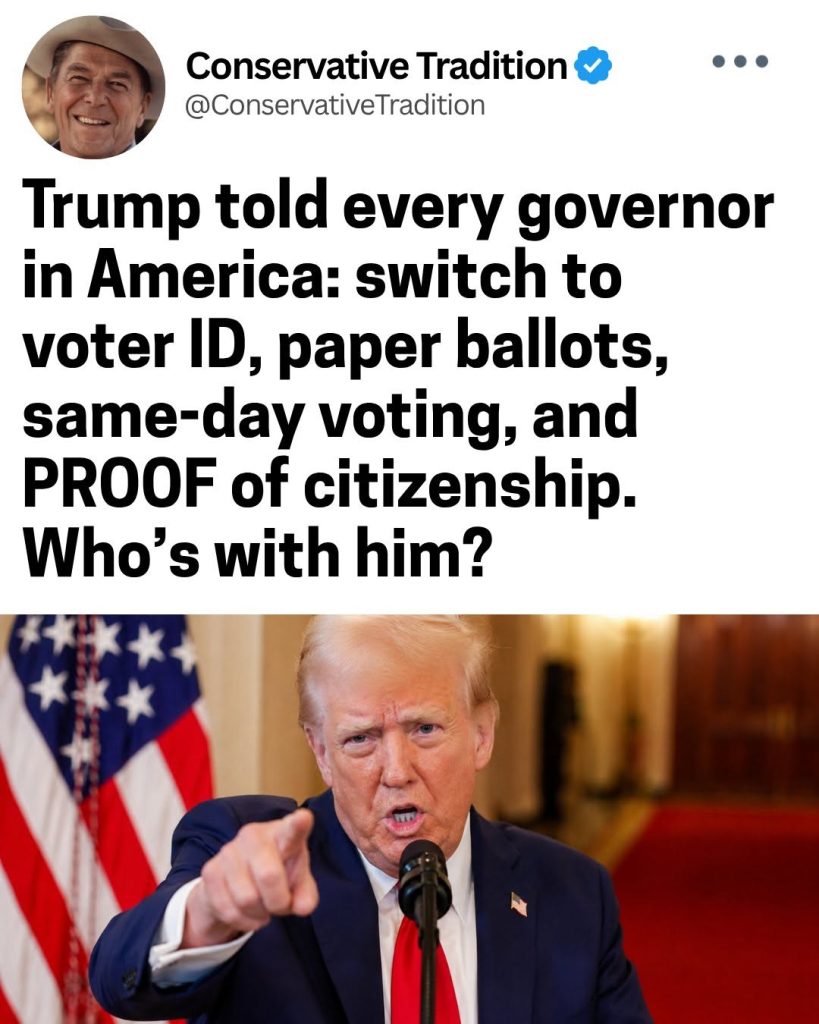
President Donald Trump laid out what he believes should be the foundation of election security in America: voter ID, paper ballots, same-day voting, and proof of American citizenship. To his supporters, these aren’t controversial ideas—they’re common-sense measures designed to protect the integrity of the voting process and restore public confidence in election outcomes.
The argument is straightforward. Supporters of voter ID requirements point out that identification is required for countless everyday activities, from boarding a flight to opening a bank account. They ask why voting—the cornerstone of democracy—should be treated differently. They believe that verifying a voter’s identity helps ensure that every ballot cast belongs to an eligible voter and that every legal vote receives the protection it deserves.
Paper ballots are another key part of the discussion. Advocates argue that physical ballots provide a tangible record that can be audited, recounted, and independently verified if questions arise. In an age where technology plays an increasingly large role in everyday life, some Americans believe that having a paper trail adds an extra layer of transparency and accountability to the election process.
Same-day voting is often promoted as a way to simplify elections and reduce concerns about extended voting periods. Supporters contend that concentrating voting into a clearly defined timeframe can make election administration easier and increase public confidence in how votes are collected and counted. Others argue that it creates a more consistent and transparent process for everyone involved.
Proof of American citizenship is another proposal that has generated significant debate. Those who support the requirement argue that voting in federal elections should be limited to eligible citizens and that confirming citizenship status is a reasonable safeguard. They view it as an essential step toward maintaining confidence in the electoral system.
At the heart of this debate is a broader question: how can Americans ensure both election security and voter access? Different people answer that question in different ways. Some emphasize stronger verification measures, while others focus on reducing barriers to participation. Both sides often say they want fair, accurate, and trustworthy elections, even if they disagree on the best methods to achieve that goal.
Supporters of Trump’s proposals argue that confidence in election results is one of the most important pillars of a healthy democracy. They believe that when voters trust the system, they are more likely to accept election outcomes, participate in the political process, and remain engaged in civic life. In their view, election security is not about benefiting one political party or another—it’s about ensuring that every eligible vote counts and that the process remains transparent and accountable.
The discussion surrounding election laws will likely continue for years to come, with passionate arguments on all sides. What remains clear is that election integrity, voter confidence, and public trust are issues that matter deeply to millions of Americans. As debates continue across the country, many citizens are asking how best to balance accessibility, security, transparency, and fairness in one of the most important processes in a democratic society.
What do you think? Should voter ID, paper ballots, same-day voting, and proof of citizenship become nationwide standards, or should states continue deciding their own election rules? Join the